Friday, January 9, 2009
Visual poet
Last night I watched this half hour interview with Joel Meyerowitz from the mid-80s. I think if things had shaken out differently, Meyerowitz could've been a poet instead of a photographer. He has a very eloquent manner which becomes even more noticeable when set side by side with the stiff deer-in-headlights questions of interviewer Barbara Lee Diamonstein. There are no ums and ers, just forthright description which in a way mimics his photography. The clip shows a brief range of his work including one or two early b/w images which were new for me. For someone so closely identified with color it's interesting to note that his b/w work is just as strong. Visual poetry runs all through his work no matter the format or chromatic property.
Warning: The clip is long and takes a while to load. Imagine you're on a busy corner watching pedestrians. Wait for it...wait for it...things are falling into place, not quite yet....Now! See? Told you it was worth it.
More Diamonstein interviews with photographers can be found here including one with Winogrand.

Wednesday, January 7, 2009
Buzzy Sullivan isn't bored
If you're ever stuck in a photographic rut, you could try try one of Buzzy Sulllivan's techniques. I don't know much about this guy or even if that's his real name. He lives in Portland. He's inventive. Here are some things he's tried:
 "Double exposure of lights and the St. John's bridge taken through the windshield with fuji velvia 100, cross processed with my Diana."
 "35 mm homemade pinhole shot. I made the pinhole out of a cereal box, two film canisters, a paper clip, and a soda can. Oh and a lot of electric tape."
 My favorite Holga shot with burnt plastic lens. Moving train out of focus. No photoshop."
 "Holga half frame I made with cardboard from a film box taped inside. Shoot your roll, get in a darkroom, or car trunk in my case. Roll the film by hand back to the original spool. Flip the cardboard in the camera and shoot the roll again."
 "This here is Mr. sewing machine shot with my Nikon f3 with Tmax 3200 through the viewfinder of an Anscoflex."
 "This image is two 5x7 prints made from paper negatives shot separately in a quart paint can that I made into pinhole. I crumpled and tore the paper before I loaded it to be shot. The exposures were pretty long as I was shooting paper about the equivalent of asa 4. After I shot the photos I dipped the negatives in developer and pulled them out a few times till I got what I wanted making sure no even development would happen on my watch."
 Solargraphy image of 10 days worth of sunrises of a Portland winter from my porch. The dark spots on the left & the blob on the right are water spots where rain water leaked into my pinhole."
 "Holga shot with nylons streched inside my camera. no photoshop."
 "Photogram with some burnt and oiled plastic, a heart diagram, and a screen printed image of a woman kicking a man's ass on broken glass."
 Holgaroid double exposure, on type 80 chocolate polacolor sepia film."
 "Double exposure of lights and the St. John's bridge taken through the windshield with fuji velvia 100, cross processed with my Diana."
 "35 mm homemade pinhole shot. I made the pinhole out of a cereal box, two film canisters, a paper clip, and a soda can. Oh and a lot of electric tape."
 My favorite Holga shot with burnt plastic lens. Moving train out of focus. No photoshop."
 "Holga half frame I made with cardboard from a film box taped inside. Shoot your roll, get in a darkroom, or car trunk in my case. Roll the film by hand back to the original spool. Flip the cardboard in the camera and shoot the roll again."
 "This here is Mr. sewing machine shot with my Nikon f3 with Tmax 3200 through the viewfinder of an Anscoflex."
 "This image is two 5x7 prints made from paper negatives shot separately in a quart paint can that I made into pinhole. I crumpled and tore the paper before I loaded it to be shot. The exposures were pretty long as I was shooting paper about the equivalent of asa 4. After I shot the photos I dipped the negatives in developer and pulled them out a few times till I got what I wanted making sure no even development would happen on my watch."
 Solargraphy image of 10 days worth of sunrises of a Portland winter from my porch. The dark spots on the left & the blob on the right are water spots where rain water leaked into my pinhole."
 "Holga shot with nylons streched inside my camera. no photoshop."
 "Photogram with some burnt and oiled plastic, a heart diagram, and a screen printed image of a woman kicking a man's ass on broken glass."
 Holgaroid double exposure, on type 80 chocolate polacolor sepia film."
Monday, January 5, 2009
What To Do? #9

 26. SE 34th and Hawthorne, Portland, 2004
 27. Ladd's Addition, Portland, 2002
Exceptional photographs
I used to send and receive letters in the mail with some regularity. About 10 years ago email began to supplant snailmail and I did less of my correspondence through letters. At this point the conquest is complete. Email is king, and it's quite rare that I send or receive anything physically handwritten.
The one exception occurs annually around this time of year when holiday cards go out. For a week or so, the mailbox becomes personal. We try to get a holiday card out to all the folks in the Rolodex, and in return we receive updates from afar.
By and large these updates tend to consist of one simple thing: a photo of the kids. Forget all the things that happened in the past year, all the little incidents and dramas. You could try to put it in words but at the end of December, when you want to show where you've come in the past year you show a photo of the kids. Nothing else needs to be said.
Kids change quickly. If you haven't seen a certain child in a while, since the last holiday card for example, then you'll be amazed how old he/she looks now. A photo of an adult doesn't have the same effect. What's even more amazing is that generally the older a child gets, the more his/her parents features begin to come out. There are certain long lost friends we haven't seen in years. Maybe I've never even met their kids. But when I look at the holiday card, Holy Cow! It looks just like X. A simple observation I know yet every year I am blown away as if this were a new discovery.
Holiday photos are beautifully accurate. They tend to be smiling, flashlit, and unambiguous. A seasonal border encircles the image. Winogrand said about the family snapshot "When they're talking about snapshots they're talking about the family album picture, which is one of the most precisely made photographs. Everybody's fifteen feet away and smiling. The sun is over the viewer's shoulder. That's when the picture is taken, always. It's one of the most carefully made photographs that ever happened."
Here's a small handful of carefully made photographs we received recently:
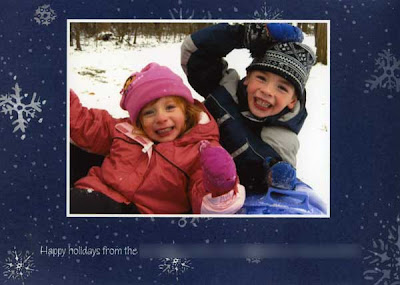



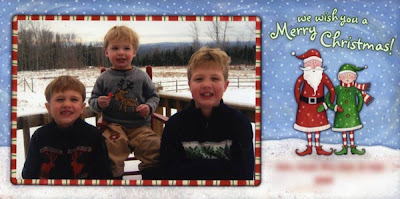

And here's the one we sent out:
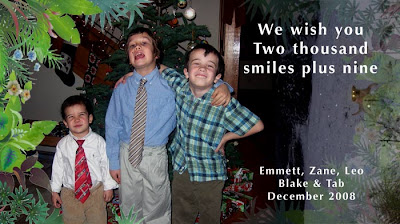
Since holiday cards are private correspondence, posting them without permission on a public blog is a bit of a taboo. I'm guessing that as you looked through them, you felt a shudder and thought, "You can't just put pictures of poor defenseless kids out there!" I think that sense of unmasked anonymity gives them some energy.
Yet look at them again. They're still just as anonymous. You have no idea who these people are, and that's really where their power lies. When I look at them I see one thing --pictures of dear friends and family-- yet to anyone else their meaning changes completely. The audience activates the photo.
This is the way most photographs operate but I don't think it's commonly acknowledged. The person who takes a photo almost always has a very different understanding of the image than anyone else. He/she was at the scene at the moment of exposure. All those memories and thoughts filter the photo's meaning. For anyone else it might as well be a stranger's Christmas card.
The one exception occurs annually around this time of year when holiday cards go out. For a week or so, the mailbox becomes personal. We try to get a holiday card out to all the folks in the Rolodex, and in return we receive updates from afar.
By and large these updates tend to consist of one simple thing: a photo of the kids. Forget all the things that happened in the past year, all the little incidents and dramas. You could try to put it in words but at the end of December, when you want to show where you've come in the past year you show a photo of the kids. Nothing else needs to be said.
Kids change quickly. If you haven't seen a certain child in a while, since the last holiday card for example, then you'll be amazed how old he/she looks now. A photo of an adult doesn't have the same effect. What's even more amazing is that generally the older a child gets, the more his/her parents features begin to come out. There are certain long lost friends we haven't seen in years. Maybe I've never even met their kids. But when I look at the holiday card, Holy Cow! It looks just like X. A simple observation I know yet every year I am blown away as if this were a new discovery.
Holiday photos are beautifully accurate. They tend to be smiling, flashlit, and unambiguous. A seasonal border encircles the image. Winogrand said about the family snapshot "When they're talking about snapshots they're talking about the family album picture, which is one of the most precisely made photographs. Everybody's fifteen feet away and smiling. The sun is over the viewer's shoulder. That's when the picture is taken, always. It's one of the most carefully made photographs that ever happened."
Here's a small handful of carefully made photographs we received recently:


And here's the one we sent out:

Since holiday cards are private correspondence, posting them without permission on a public blog is a bit of a taboo. I'm guessing that as you looked through them, you felt a shudder and thought, "You can't just put pictures of poor defenseless kids out there!" I think that sense of unmasked anonymity gives them some energy.
Yet look at them again. They're still just as anonymous. You have no idea who these people are, and that's really where their power lies. When I look at them I see one thing --pictures of dear friends and family-- yet to anyone else their meaning changes completely. The audience activates the photo.
This is the way most photographs operate but I don't think it's commonly acknowledged. The person who takes a photo almost always has a very different understanding of the image than anyone else. He/she was at the scene at the moment of exposure. All those memories and thoughts filter the photo's meaning. For anyone else it might as well be a stranger's Christmas card.
Thursday, January 1, 2009
Mike Peters: What Was He Thinking?
Mike Peters is the staff photographer at Montclair State University in Montclair, NJ. The images below are from his personal work making street photographs in and around NYC. More of his photos can be seen on his website.

"A few months before this point I had just decided to start shooting on the street again. I used to wander my neighborhood with my 4x5 and photograph people, but it had become too cumbersome and I had become more interested in making spontaneous images. I had used square format professionally, and on a few personal projects, and decided that it would be the best compromise between 35 and 4x5, plus I loved the formality and uniformity of the frame so I picked up a Seagull TLR to see if it would work out. This was shot while riding the Staten Island Ferry on a family outing. I saw the interaction of the couple on the left and loved the gaze she was giving him and the position of their legs. They were what I was after and the others were like extras. As an extra added bonus, the way the structure of the ship added to the frame and the quality of the light were all working in my favor. In other words it was a total gut reaction. I saw, composed, and shot."

"Forty Second Street and Broadway is always a place where something is happening. I was walking west and noticed the man handing out fliers to passers by. He had a placard that read "Restore Old Photos" very crudely written below amazingly cheesy images. I decided to delay my trip for a few minutes and waited around while he attempted to hand out his allotment of fliers. I was struck by his invisibility to people as they rushed by him, and by the odd ways in which people seemed to be going in different directions all at once. I clicked off a few frames and went on my way, convinced that I was as invisible to people on the street as the man with the placard. Everyone seems to be in their own little world or cell phones, ipods, girl watching, whatever. And then there is my world, constrained by the four equal sides of the viewfinder."

"I'm one of those geeky photographers that constantly checks his meter as I walk down the street. You would think that after 35 years of making photos that I would just know what the exposure is, but no, I am a slave to the meter on my wrist. I was walking down 7th Ave in the middle of Times Square, adjusting my exposure to match the reflection of the light coming off the building when I noticed everyone in front of me looking up. Pre-focused, all I did was raise the camera to my eye, compose and shoot, the trash can a mere element to the frame. When I lowered the camera, I noticed the image on the can and laughed. I have no idea what they were looking at."

"The South Street Seaport in NYC is both a tourist trap and shopping mecca. It's one of those places that pisses me off. I don't get why people will come from the midwest to shop in the same store in NYC that they can find in their local mall, or why locals would deal with the dearth of parking. Nonetheless, it is a great place to find people indulging in the great American pastime without having to dodge mall security because I have a camera. It was hot, humid and they were exhausted and bored to death. The kid on the left seemed just thrilled to have a new vacuum cleaner while his mother was inconsolable from having to say no you can't have this and that to him and his little fidgety brother ten thousand times. I recognized and identified with everyone's expression and body language as I saw the scene unfold before me, from the point of view of the kids and the parent. Shopping is hard work. I noticed them as I wandered by and couldn't help but make a record of their misery."

"This was my first foray out with a new camera, and I was sure I had made a mistake giving up my Rolleiflex TLR for a Hasselblad. You see, the lens I wanted with the Hassy was on the longish side of normal at 110 mm, like 55 mm on 35 format, and I was struggling. As I turned the corner of 42nd and 5th I immediately saw this man slowly walking towards me, it was a warm day and he had on a raincoat, his expression seemed to be somewhere between total exhaustion and sheer terror. I couldn't really make it out but I knew what he was feeling. I paused in the middle of the sidewalk just as he stopped to remove his coat. I lifted the camera to my eye, he caught the gaze of my lens, kerchunk went the mirror/shutter, and we both went on our way. After this, I was now sure I had not made a mistake as the longer lens seemed to be able to isolate people a bit more than the 80."

"Making sense of the chaos that unfolds on the streets of NYC can be difficult. There are times however when you come across a spot where you just know something will happen. Usually you are wrong but not always. I noticed this little slice of the corner of 34th Street and 7th Ave as a place that was a bottleneck for pedestrian traffic, the guys on either side making a bad situation worse by being in the way. It seemed ripe with possibility, so I stopped, pre-focused, composed and waited. Not having a motor wind meant that I get one shot at any given moment, so the voice of Homer Simpson saying "wait for it!" seeps into my head. I saw the woman with the big bag walk in front of me and I waited for her to pass by the man on the left while at the same time seeing the mother in the middle dragging her son along. I knew I had something, but it wasn't until I saw the contact sheet that I was sure."

"34th Street and Broadway is one of those intersections where if you just happen to hang around long enough, things will happen. This well dressed little boy was thrust by a gaggle of female relatives into the middle of the sidewalk so they could take snapshot of him with Macy's in the background. They all cooed and giggled while they shot away. I noticed that he was pushing his hands deep into his pockets while lowering his head in what seemed like embarrassment at being the center of attention. The crowd of pedestrians cleared around him while I found focus and made the photo, the ladies laughed and the little boy was dragged along somewhere else with them."

"About ten minutes after the shot of the little boy above, this shot was made in a way that was completely different. Whereas the little boy shot was completely in the moment, this one I waited for. I noticed the gangs of people emerging from the subway merging with the already crowded throngs on the sidewalk trying to avoid the man on the cell phone. I switched to a wide angle lens to make the diagonal of the railing into a strong element in the frame. Standing there with the camera to my eye, I thought it was interesting how people would look at the camera at they passed by, so I set focus at about 6 or 7 feet and waited for people to enter the zone. I noticed the man in the flag tie as he approached. As he passed cell phone man, he caught my lens and spontaneously flipped me the bird. Remarkably I managed to stay composed enough to press the shutter button despite being totally thrilled at what he had done. A big grin emerged on my face behind the camera, and as he passed he said "sorry" as if he had ruined the photo. No apologies necessary."

"A few months before this point I had just decided to start shooting on the street again. I used to wander my neighborhood with my 4x5 and photograph people, but it had become too cumbersome and I had become more interested in making spontaneous images. I had used square format professionally, and on a few personal projects, and decided that it would be the best compromise between 35 and 4x5, plus I loved the formality and uniformity of the frame so I picked up a Seagull TLR to see if it would work out. This was shot while riding the Staten Island Ferry on a family outing. I saw the interaction of the couple on the left and loved the gaze she was giving him and the position of their legs. They were what I was after and the others were like extras. As an extra added bonus, the way the structure of the ship added to the frame and the quality of the light were all working in my favor. In other words it was a total gut reaction. I saw, composed, and shot."

"Forty Second Street and Broadway is always a place where something is happening. I was walking west and noticed the man handing out fliers to passers by. He had a placard that read "Restore Old Photos" very crudely written below amazingly cheesy images. I decided to delay my trip for a few minutes and waited around while he attempted to hand out his allotment of fliers. I was struck by his invisibility to people as they rushed by him, and by the odd ways in which people seemed to be going in different directions all at once. I clicked off a few frames and went on my way, convinced that I was as invisible to people on the street as the man with the placard. Everyone seems to be in their own little world or cell phones, ipods, girl watching, whatever. And then there is my world, constrained by the four equal sides of the viewfinder."

"I'm one of those geeky photographers that constantly checks his meter as I walk down the street. You would think that after 35 years of making photos that I would just know what the exposure is, but no, I am a slave to the meter on my wrist. I was walking down 7th Ave in the middle of Times Square, adjusting my exposure to match the reflection of the light coming off the building when I noticed everyone in front of me looking up. Pre-focused, all I did was raise the camera to my eye, compose and shoot, the trash can a mere element to the frame. When I lowered the camera, I noticed the image on the can and laughed. I have no idea what they were looking at."

"The South Street Seaport in NYC is both a tourist trap and shopping mecca. It's one of those places that pisses me off. I don't get why people will come from the midwest to shop in the same store in NYC that they can find in their local mall, or why locals would deal with the dearth of parking. Nonetheless, it is a great place to find people indulging in the great American pastime without having to dodge mall security because I have a camera. It was hot, humid and they were exhausted and bored to death. The kid on the left seemed just thrilled to have a new vacuum cleaner while his mother was inconsolable from having to say no you can't have this and that to him and his little fidgety brother ten thousand times. I recognized and identified with everyone's expression and body language as I saw the scene unfold before me, from the point of view of the kids and the parent. Shopping is hard work. I noticed them as I wandered by and couldn't help but make a record of their misery."

"This was my first foray out with a new camera, and I was sure I had made a mistake giving up my Rolleiflex TLR for a Hasselblad. You see, the lens I wanted with the Hassy was on the longish side of normal at 110 mm, like 55 mm on 35 format, and I was struggling. As I turned the corner of 42nd and 5th I immediately saw this man slowly walking towards me, it was a warm day and he had on a raincoat, his expression seemed to be somewhere between total exhaustion and sheer terror. I couldn't really make it out but I knew what he was feeling. I paused in the middle of the sidewalk just as he stopped to remove his coat. I lifted the camera to my eye, he caught the gaze of my lens, kerchunk went the mirror/shutter, and we both went on our way. After this, I was now sure I had not made a mistake as the longer lens seemed to be able to isolate people a bit more than the 80."

"Making sense of the chaos that unfolds on the streets of NYC can be difficult. There are times however when you come across a spot where you just know something will happen. Usually you are wrong but not always. I noticed this little slice of the corner of 34th Street and 7th Ave as a place that was a bottleneck for pedestrian traffic, the guys on either side making a bad situation worse by being in the way. It seemed ripe with possibility, so I stopped, pre-focused, composed and waited. Not having a motor wind meant that I get one shot at any given moment, so the voice of Homer Simpson saying "wait for it!" seeps into my head. I saw the woman with the big bag walk in front of me and I waited for her to pass by the man on the left while at the same time seeing the mother in the middle dragging her son along. I knew I had something, but it wasn't until I saw the contact sheet that I was sure."

"34th Street and Broadway is one of those intersections where if you just happen to hang around long enough, things will happen. This well dressed little boy was thrust by a gaggle of female relatives into the middle of the sidewalk so they could take snapshot of him with Macy's in the background. They all cooed and giggled while they shot away. I noticed that he was pushing his hands deep into his pockets while lowering his head in what seemed like embarrassment at being the center of attention. The crowd of pedestrians cleared around him while I found focus and made the photo, the ladies laughed and the little boy was dragged along somewhere else with them."

"About ten minutes after the shot of the little boy above, this shot was made in a way that was completely different. Whereas the little boy shot was completely in the moment, this one I waited for. I noticed the gangs of people emerging from the subway merging with the already crowded throngs on the sidewalk trying to avoid the man on the cell phone. I switched to a wide angle lens to make the diagonal of the railing into a strong element in the frame. Standing there with the camera to my eye, I thought it was interesting how people would look at the camera at they passed by, so I set focus at about 6 or 7 feet and waited for people to enter the zone. I noticed the man in the flag tie as he approached. As he passed cell phone man, he caught my lens and spontaneously flipped me the bird. Remarkably I managed to stay composed enough to press the shutter button despite being totally thrilled at what he had done. A big grin emerged on my face behind the camera, and as he passed he said "sorry" as if he had ruined the photo. No apologies necessary."
Subscribe to:
Posts (Atom)