Showing posts with label Winogrand. Show all posts

Wednesday, January 16, 2019

Street Resurfacing, Cont.

My last post put me in a Winogrand mood, so I figured it'd be fun to share some other old ephemera. The photos below are from an early Garry Winogrand photo essay published in the debut edition of Eros, Spring 1962, which I stumbled upon in a Maine bookshop several years ago. 


I guess Winogrand's Love In The Subway fit the journal's theme. 


As far as I can tell Eros was a soft-porn journal aimed at the intellectual crowd. This was back before the sexual revolution when such subjects were taboo, so Eros had to hint at the subject sideways. It's full of double entendre and poetry and wink-wink/nudge-nudge, plus a few photos. 


The photos seem pretty tepid to me, unremarkable by today's standards. 


They're only noteworthy because of who made them and what he'd do later.


But I guess that's the crux of the issue. 


How did a 34-year old journeyman assignment photographer break through from shooting this mediocre material to his miracle year 1964 just two years later? 


Something in the water? Drugs? Indian Yogis? The sixties? The 10,000 hour rule? 


Your guess is as good as mine. Just grateful it happened.


Friday, January 11, 2019

Street Resurfacing Project

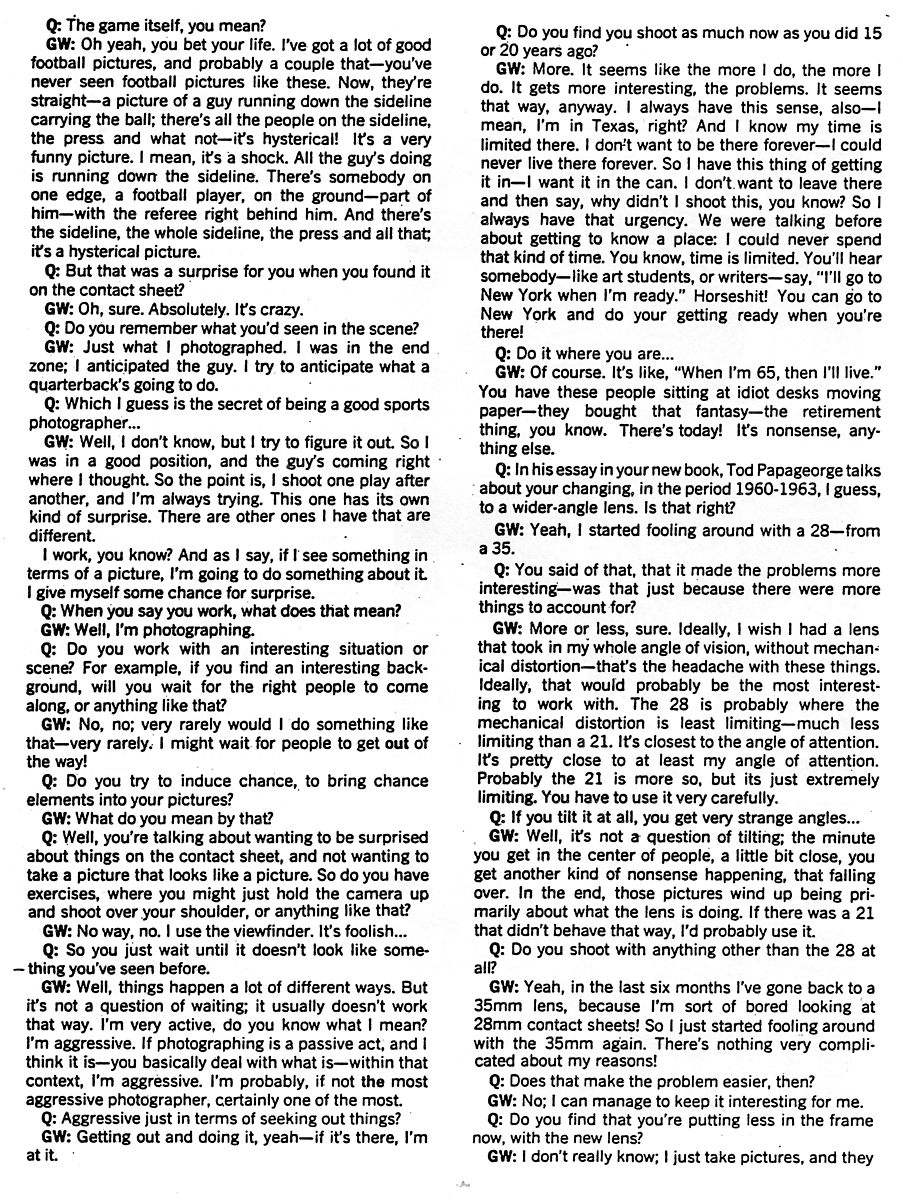
John Sypal recently sent me a photocopy of this old interview with Garry Winogrand, conducted by Charles Hagen. It was originally published in Afterimage in December 1977, just before Winogrand's 50th birthday, and arguably near the peak of his career. Some of the photos included are recognizable from Public Relations which had just been published, and Stock Photographs, which would come out a few years later. Maybe they looked ok in the original magazine, but here they're severely degraded by multiple copy/scans. So it's probably best to ignore them and just enjoy the text, which is chock full of interesting nuggets. To the best of my knowledge this is not online elsewhere. For serious photo nerds only!

1/18 Update: PDF version available here (Thanks, Ben Helton)


Monday, April 30, 2018

"I really try to divorce myself from any thought of possible use of this stuff."

For a photographer with so many memorable quips to his name, Garry Winogrand didn't leave much of a paper trail. The four books he made during his lifetime (five if you count the 1976 Grossmont College booklet) consist almost exclusively of pictures. Although they also include some great essays, none are by Winogrand. Nor did he write for any outside books or sources. 

The most he contributed to any publication was the pithy half page intro to the Grossmont catalog, insightful but abbreviated. Winogrand also wrote a brief introduction to Stock Photographs, but it was merely a perfunctory passage which said nothing about the photos. Outside of those few instances the longest surviving Winogrand essay came about only through rote task. That was his much quoted Guggenheim application written in 1964. You know the one, 
"I look at the pictures I have done up to now, and they make me feel that who we are and how we feel and what is to become of us just doesn't matter. Our aspirations and successes have been cheap and petty…I cannot accept my conclusions so I must continue this photographic investigation further and deeper. This is my project…" 
Winogrand's 1964 Guggenheim essay
Until recently I hadn't read that essay for a long while, and in my memory it laid out Winogrand's ideas about photography and planned approaches for the year of shooting. But a fresh revisit belies all of those notions. The essay actually says very little about photography apart from "photography, photographers, photographs deal with facts." Instead it's a sort of gateway to the 1960s, as were some of the photos to come.

When it comes down to it, almost none of the famous Winogrand aphorisms we know and love were written by him. Instead they come to us secondhand, transcribed by acolytes: 

"I photograph to find out what things look like photographed."

"Great photography is always on the edge of failure."

“Every photograph is a battle of form versus content." 

Thank god someone was around to record that stuff. As an oral sage Winogrand's in fine company, right up there with Socrates and Jesus, at least in the photo world. Like them his lectures are the main material extant. But Winogrand's were far more prickly, closer to Confucius than any western prophet. Here's an excerpt from RIT in 1970:
RIT audience member: I saw a photograph that—there’s a photograph that had “Kodak” and there’s a kid holding a dog— 
Garry Winogrand: Yeah. 
RIT: —and the people kind of wandering in and out. Now, it might be due to my own ignorance or something, but could you give me like a straight answer as to what you’re trying to say in that photograph?
GW: I have nothing to say. 
RIT: Nothing to say? Then why do you print it?
GW: I don’t have anything to say in any picture.…My only interest in photographing is photography. That’s really the answer. 
RIT: Why do you print it if it has no meaning? 
GW: With that particular picture—ah, I’m interested in the space and I maybe can learn something about photography. That’s what I get from photographs; if I’m lucky, I can learn something. 
RIT: Then you’re trying to reveal something about space? 
GW: I’m not revealing anything. 
RIT: Then what do you think is the purpose of the photograph if you’re not revealing anything. 
GW: My education. 
RIT: Then what’s the purpose of that? That’s what I’m trying to find out. 
GW: That’s the answer. That’s really the answer…
Poor RIT student. Getting critical analysis out of Winogrand was like pulling teeth. And his photos aren't much help. They're just as awkward and inscrutable as his lectures.

It's not that he didn't give a shit. Indeed, Winogrand cared and thought deeply about his photos. But he was reticent to guide any specific interpretation. "Photos have no narrative content," he said. "They merely describe light on paper." Raw visual description of the world, that was the thing! How might reality translate into a two dimensional four walled box? Here's how: "When you put four edges around some facts, you change those facts." The mutability of such facts, even frozen in silver, was the source of endless possibility, the only motivation needed, and its own answer. No need for art mumbo-jumbo. 

But still, would it have killed him to get something in writing? 

Garry Winogrand, 1957, by Lee Friedlander


Fortunately he had a crack team of writer friends to do the heavy lifting. Helen Gary Bishop, Leo Rubinfien, and Tod Papageorge all contributed introductions to his monographs, each one stellar. Winogrand's direction to Papageorge (Public Relations) was simple enough: "I don't care what is written just so long as the photography is not discussed." But the plea fell on deaf ears. Papageorge's essay did in fact discuss the photography. Oh well. Its verbosity was balanced out by Winogrand's own contribution to Public RelationsHere it is, in its entirety: 
"The way I understand it, a photographer's relationship to his medium is responsible for his relationship to the work is responsible for his relationship to the medium." 
In other words, if you're trying to understand what my photos are about, take a hike.

If Winogrand were to codify a relationship to his medium, it centered on process. The daily act of looking and translating the visual world into photographs wasn't just an obsession, it was integral to his existence. It was his waking state. "I get totally out of myself. It's the closest I come to not existing." In the end shooting consumed his energy to the exclusion of other tasks. Small irritants like developing film, looking at it, and pruning the resulting photos into a cohesive structure — the steps normally necessary to transform exposures into some viable archive —all fell by the wayside. 

Normally this would doom one's legacy. Instead Winogrand's myopic devotion has only burnished his. Three thousand undeveloped rolls, or whatever the number is, are now just an element of the myth. Since his untimely death in 1984, his star has risen steadily. A new feature length documentary bio is about to hit theaters. He is the subject of eight posthumous books and counting. And —despite his sentiments regarding photo theory—these books are chock full of analysis. That's not to say he would hate them all. But we can probably assume he would be mildly irritated.

Reevaluating Winogrand has become something of a critical parlor game, and since he left such a thin paper trail, the field is wide open. He's like Vivian Maier, Disfarmer, and Bellocq all rolled into one, a tabula rasa. Better yet, he's a street photographer (a term he hated), a genre which has exploded in popularity since his death. 

The basic formula is to gain access to the Winogrand archives at the University of Arizona (somewhere north of 1 million film exposures, depending on who's counting), craft a new edit featuring at least a few "unseen" photos, then perform a critical reappraisal of his photography, his life choices, and how he might —or might not— fit into a historical context. There's a sense of ok, he died with unfinished business, let's finish it for him. Kinda like Socrates or Jesus.

In the mid-eighties, when curators were still developing and editing his unseen rolls, his archive was a jungle of untapped potential. Szarkowski had a field day with Figments From The Real World in 1988. All the rolls have since been developed, and by now every frame seen by at least someone or other, at least by Leo Rubinfien if not others. 

In some ways it's a spent mine, and curators are now sifting through pre-examined tailings. But new ideas, new edits, and new Winogrand books keep coming, each one taking a slightly different tack. They run the gamut from Alex Sweetman's Archive 26, written from an adversarial stance, to John Szarkowski, who championed Winogrand against all doubters and called him "the central photographer of his generation." Others —Trudy Wilner Stack, Jeffrey Fraenkel, Alex Harris, Lee Friedlander, and Leo Rubinfien— fall somewhere between, bewitched to varying degrees by his spell. 

The Street Philosophy of Garry Winogrand, 2018, by Geoff Dyer

The latest is by Geoff Dyer, author of The Ongoing Moment and occasional New York Times photo critic. His The Street Philosophy of Garry Winogrand has just been published by University Of Texas Press. Winogrand's directive —"the photography is not discussed"— may not have worked on Papageorge but it's found a more receptive audience in Dyer. His essays dance around a variety of topics and tangents including literature, painting, poetry, sex, travel, and television. Yes, they do discuss the photography too, but it has a secondary role, merely a departure point for Dyer's whirlwind of ideas and speculation. Winogrand's photos are included too, but almost as an afterthought. A better title might be The Street Philosophy of Geoff Dyer.

Winogrand was famously averse to analysis, yet Dyer was commissioned to write just such a book. So the whole enterprise is problematic from the get-go. To his credit he addresses the dilemma directly in the introduction: "In my notes, for reasons I can no longer fathom, I kept reminding myself that this should not be a book about photography. Well it is about photography, obviously." An explanation which may not settle the issue, but is quite Winograndian. 

Atget, 2000, John Szarkowski
Dyer's book is modeled on Atget, the MoMA book published in 2000 by the aforementioned Szarkowski. For that book, Szarkowski picked 100 photos by Eugene Atget, wrote an essay on each one, then laid them side by side in what's become a classic of the genre. The writing is sharp and the model simple, two traits borrowed by Dyer for his tome. 

Dyer's book sequences 100 Winogrand photos in roughly chronological order (a slight departure from Szarkowski. Atget is not chronological), each sharing a spread with a short essay. The photographs tend to loosen up over time as Dyer traces the course of Winogrand's career from tidy fifties candids to his final days spewing motor driven exposures all over the passenger seat. Dyer's writing follows suit. The book's early essays are fairly conventional, but they begin to shift in tone beginning around the midpoint. The unmooring gathers steam as later essays dip a toe in the stream of consciousness, speculating on phone booths, gender bending, and animal magnetism. This proves the perfect accompaniment to Winogrand, whose late work has always been something of a stumper to critics. Szarkowski, for example, famously dismissed it. Dyer's assessment is much kinder, helped along by his poetic sensibility.

Poetic or not, I think the word Psychiatry would fit better in a Winogrand book title than Philosophy. He was a street psychiatrist, almost a clairvoyant. As reluctant as he was to analyze photos, strangers he could analyze with penetrating insight. He possessed an uncanny ability to size up people in public, single out the ones dealing with problems, and reveal that internal turmoil in his photographs. Almost all of them depict a central person or group of figures cleanly framed, his photos a hotline into their minds. In photo after photo his does this, somehow setting aside the extraneous to focus on the interior. According to Friedlander he was "a bull of a man, and the world his china shop," yet one with extraordinary sensitivity. China shop be damned, the world was his analyst's couch.

Part of Winogrand's psychiatric makeup was his chauvinism. He personified the male gaze. Walking the sidewalks of the 1970s New York, leering through his lens at gorgeous women —Yes, that was him, the predecessor to a small cottage industry of contemporary street voyeurs. Many of Winogrand's photos seem to be simply about ogling females and not much more. To be fair, he ogled everyone, male or female. But beautiful women were a favorite subject. 

To Winogrand's credit he owned it. Women Are Beautiful may be a provocative title for a photo book, but at least it's less sexist that Winogrand's original working title, Confessions Of A Male Chauvinist Pig. Winogrand made no attempt to hide his leericism. Still, I think the original title would not have aged well. 

Dyer addresses Winogrand's male gaze by curating a selection with a large dose of Women Are Beautiful style photos. Some were included in that book. Others are new. Whether this is an homage to Winogrand's chauvinism or a reflection of Dyer's own bias is not clear. But whatever the reason the book's primary thread is women, and Dyer's book contains a higher concentration than any of the other posthumous books. 

Photo #3 in The Philosophy of Garry Winogrand


He sprinkles them in a series through The Street Philosophy, comparing and contrasting the depiction of women as he progresses chronologically through Winogrand's career, which roughly coincided with the rise of feminism. In one of the opening photos, shot during "the pre-feminist" world, a woman walks demurely with eyes on the sidewalk, "an early example of a classic Winogrand street scene." By the middle of the book women strut before Winogrand, highbeamed and brazen, or as a sexpot mannequin, or eating ice cream with a smile, or strolling in full color down Fifth Avenue. Dyer plays with the idea of following the "same" women in various photos throughout the book, although of course each subject is unique.

By the last few pages the chronology has reached the early 80s, just before Winogrand's death, and his male gaze has melted into hedonist abandon. A contact sheet of frames from Hollywood's Ivar Theatre shows a stripper exposing herself —every last inch of it, in a stroke of proud bravado— to a pack of men during the club's regular camera night. Dyer's essay is unrestrained, 
"You glimpse a woman on the street and fall in love for a second and if you're a photographer that is great, but if you're lucky enough to talk to her and perhaps go on a date and go to bed with her and make love then at some point, although you want to see her face and feel your love for her reflected in her eyes, you also want this —this crudity..." 
Hm, so that's what the photos are about after all? Boy meets girl? They screw. Is it that easy? 

Winogrand was a regular denizen at the Ivar, along with many other famous LA photographers of the time. He shot thousands of frames there, some of which have surfaced in the years since. To my knowledge the frame highlighted by Dyer is printed here for the first time. It's a curious choice, especially when printed side by side with the full contact sheet. There's not much to recommend the photo aside from, well, crudity. Maybe that's the point.

It's tough to say exactly what drew Winogrand to the Ivar, whether it was naked lust, sheer spectacle, or maybe some combination. Perhaps here his famous aphorism (one of the few he expressed in writing) applies: "There is nothing as mysterious as a fact clearly described." Here was the mystery of the female fact clearly described, laid open before the camera, the same naked truth which mystifies all men.

Sun. Photo Night — Bring Your Camera
(1977 Ross MacLean Collection)
Dyer's essay on the Ivar is probably my favorite in the book, the closest to a free rambling —and, yes, crude— dream. I can overlook its speculative quality because mysterious facts aren't the point here. Instead: fantasy. Like any good street shooter Dyer works best when he has room to stretch out and explore, "when he lets himself get deeply, comically weird," as Jennifer Szalai describes it. For me that's the main thing he's contributed to the Winogrand canon. We've had plenty of critical analysis, thank you. But until Dyer, not nearly enough wandering tangents.  

If Dyer is an entertaining essayist he's less successful as a photo curator. The selection is, frankly, a mixed bag. There are several great photos but also some clunkers. Part of the problem is that he's made a conscious attempt to pull from equally from across Winogrand's career. Some of the earlier work —made circa 1960 when Winogrand was not yet very good— seems half baked. Too many are shot with long lens and short depth of field, techniques Winogrand would later abandon for good reason. The late career photos hold up poorly too in comparison to the sweet spot, roughly 1964 - 1977.

Dyer has explained that some images were chosen more for the essay they might generate than for their inherent visual quality. I suppose that's a partial explanation, but not completely satisfying. After all, this is a new book of Winogrand! Dyer has access to a million unseen frames. Show us the goods! The selection of color work in particular is disappointing. We haven't seen much of it to date, and perhaps the promise of new color led to unreasonable expectations. But judging by the photos presented here, I can't help wonder if Winogrand's small color oeuvre has been mostly picked clean already. It's hard to know without visiting the archives in person.

Photo #20 in The Philosophy of Garry Winogrand


One notable exception is a rarely seen color photo of monkeys, pizza, and an open convertible top from 1964. The composition, layering, and general weirdness is spectacular. It's a top notch photo, even if somewhat untypical of Winogrand's style —closer to Huger Foote or Wolfgang Zurborn than a street prowling candid. It's one of his few with no psychiatric impact. Unfortunately the publisher has mangled the color palette, or perhaps they've just tried to preserve the color cast of crappy old slide film. Hard to tell. In any case it's way off. It's even more unfortunate that Dyer uses this photograph as the basis for an essay about color.  

I think Dyer's main curatorial problem is he's looking at the photos as a writer, not as a photographer. As I leaf through The Street Philosophy of Garry Winogrand I can't help inserting myself into each scene, and the questions come in a flood. Why did he stand here not there? How close could he get? What brought him to that place? Who was he with? What else has happening nearby? Why did he walk down that street? How long did he stay at that scene? Did he notice that stuff off to the left? Why did he shoot it from that angle? Those are the natural questions a photographer might ask. And what makes Winogrand's photos so wonderful is they are tough to solve. Some photos work just because they work. Period. And most photos don't, for the same reason. Why? Who knows. But overanalysis —philosophy, if you will— often doesn't help the process.  

The alternate approach, shared by Dyer and most outside curators, is to view Winogrand's photos as finished products. The emphasis is more on the meaning of the photo than how it came about. What does it express? How does it fit into his career, or into the culture? In this consideration philosophy can be quite helpful. Mandatory, even. But it's not necessarily the perspective of Winogrand. "I really try to divorce myself from any thought of possible use of this stuff," he once said of his photos. "That's the discipline. My only purpose while I"m working is to try to make interesting photographs, and what to do with them is another act...Certainly while I'm working I want them to be as useless as possible."

Useless indeed, unless publishing posthumous monographs. I'm sure Dyer's book won't be the last on Winogrand. Another one will come along in, say, five years or so. But for now it's the current gold standard. It's a big, handsome clothbound production, built to last. If you're a fan of Winogrand it belongs in your library. In fact you probably own it already. 

If you're not a fan, I doubt this book will convert you to the cause. Winogrand remains as unapproachable as ever. He was a tough nut, and it takes a while to get beneath the shell, and even then the prize is ambiguous, just a bunch of light on paper. 

Thursday, July 24, 2014

Carving the rubble

Garry Winogrand,
Showing at the Met,
June 27th - Sept. 21, 2014
There’s an old joke that sculpture is easy. To make a statue of something complicated —say a violin— just take a block of marble and remove everything that’s not a violin.* Simple, right?

I think the same premise could apply to Winogrand’s legacy. Finding his good photographs is easy. Just remove all the thousands of shots that fell short and Voila. A violin! 

Simple, right? No, not exactly. As with sculpture the crux is in the gleaning. That chore was tough enough in his lifetime, with his (sometimes grudging —culling was not his calling) input. Now that he’s dead it’s quite a challenge. But that hasn’t stopped people from trying. His massive oeuvre has been carved up in all sorts of ways. Maybe the result can garry a tune. Maybe not. One thing you can count on: there will be strings attached. 

The most recent effort is Leo Rubinfein's Winogrand exhibition and book. Rubinfein knew a blank hunk of marble when he saw one. "There exists in photography no other body of work comparable in size or quality that is so editorially unresolved," he wrote before sifting through it carefully frame by frame. I blogged briefly about the results last year when they premiered premiered at SFMoMA, with links to some of the hoopla generated at the time. Now the show has moved on to the Met and generated a fresh round of reactions, with reviews in The New Yorker, The New York Times, The Guardian, Design Arts Daily, Vice, Hyperallergic, The Daily Beast, Vanity Fair, Feature Shoot, and probably other places too. It's spurred concurrent shows. Even Winogrand's old nemesis A.D. Coleman has been inspired to join the fray, though not exactly inspired to rethink his 1980s review.

Why all the attention? Most of Winogrand's best photos would bore the crap out of people if they were shown as singles without his name attached. Yet the press fawns. What gives? Why does Vanity Fair alla sudden care? 

Beyond the obvious cause and effect —many media outlets received a press release from the Met in June and knee-jerk reacted soon after, and because the photos are finally in New York!— one reason Winogrand entices is that his photos don't explain themselves very well. "Nothing is as mysterious as a fact clearly described," he described them, somewhat mysteriously. The only certainty is that his images visually record the subjects captured within the frame. What are they about beyond that? Who knows? The answer probably varies depending on who's asking. 

One trend in recent reviews —and I think the wrong one— is to cast Winogrand as social pundit. "Garry Winogrand," writes Justin Jones, "... captur[ed] the monumental era of rapid social change and economic prosperity post-World War II climate while documenting the traumatic assassination of President John F. Kennedy and the violent reactions to an impending Vietnam War." Jonathan Jones writes, "Perhaps more than any other photographer he documented the hopes as well as the hysteria of 1960s America." For Holland Cotter, "the Met show is engrossing, especially, I would guess, for anyone who had an experience of the world that Winogrand moved in, cared about and recorded with a fanatical vigor. And that world, early, and really always, was middle-class life in New York City." In other words he was like Gene Smith. But artsier, with tilted horizons. 

I think this is Rubinfein's view, and he's organized the show accordingly. From Down From the Bronx to A Student of America to Boom and Bust, the curatorial emphasis is on post-war history. And from a certain angle even Winogrand seems to support this view. One of his quotes, cherry picked into the Met's press page: "You could say that I am a student of photography, and I am; but really I'm a student of America." One can hardly blame the press for adopting Rubinfein's perspective. Not only are they seeing the show through his point of view, they're press. Being socially concerned is their job.

Then again Winogrand said a lot of things. It doesn't take much digging before his quotes begin to contradict one another. He also said "Photography is not about the thing photographed. It's about how that thing looks photographed." and "Photographs have no narrative content. They only describe light on surface." So you could cherry-pick those quotes and come to conclusion he didn't care much about society. 

If it's confusing I think a lot of the obfuscation was deliberate. Winogrand enjoyed ambiguity. He cast off zen aphorisms like dead skin, geared more at the mountainside cave than critical analysis. "Every photograph is a battle of form versus content," sounds more like Ram Dass than Henry Horenstein. By plan. Winogrand put the photos out there, sprinkled some quotes near them, and then it was up to the viewer. 

In my opinion Winogrand was concerned mostly with photographs for the sake of photographs. New York and the post-war boom may have appeared in his images but only as an artifact of circumstance, because it's where and when he lived. If he'd lived in 1930s Japan or 1980s Argentina his photos would've shown those worlds instead, but they wouldn't necessarily comment on those societies. They'd be more about the never-ending puzzle of squeezing the world into a four-sided frame. "I really try to divorce myself from any thought of possible use of this stuff," he said. "That's part of the disclipline. My only purpose when I'm working is to try to make interesting photographs, and what to do with them is another act - a consideration. Certainly when I'm working I want them to be as useless as possible." In other words, shoot first ask questions later. Maybe I'm wrong. Maybe I'm trying to squeeze him into a box of my making. But that's how I see his photos. 

Carl Gunhouse sympathizes with this view: "Not like other art types of the early to mid 60's Wingorand was looking to find a place for himself artistically and first and foremost the work is about him and his general emotional state which tends to be bleak and nihilistic. Now for the run of his good work mid 60's-early 70's making bleak and nihilistic work in America featuring the strangers as your actors, you can make a case for a general commentary on the state of things. But I would argue his importance was pushing art photography more directly into the personal expression instead of being a formalist endeavor or about a greater social themes."


So some viewers cast Winogrand as socially concerned. Some don't. Fine. Perhaps the major factor in how you view his work is if you've tried to do that sort of thing yourself. If you've walked around with a camera looking for photos that stand on their own you realize it's damn hard. To come up with as many as he did might seem impossible actually. On the other hand, if your main experience of photography comes to you in digested visual chunks through media outlets or displayed on a wall, you might think of photographs in a different way. They might tell you the daily news. And if you're a photo critic sitting at a desk most of the day, who knows what you'll make of them.

That might describe the difference between Paul Graham's reaction and A.D. Coleman's. Graham has been shooting photographs for many years, and his late colleague's skill excites him: "It's awe-inspiring to me, that ability to marshal the world and the flow of life into those few little, extraordinarily powerful moments. We all recognize the Amazonian river of life flowing post us continually, and we usually find a quiet little corner to contemplate in. Winogrand was someone who said, 'Give me the rapids,' and he swam across them many times."

Meanwhile, far from the Amazonian river of life, A.D. Coleman has a different reaction. Um, scratch that. Actually he has no reaction at all because he stubbornly refuses to see the nearby show, but proudly clings to his 26-year old dismissal: "Winogrand’s main usefulness to the medium will be seen to have been his willingness to go down this dead-end path and explore it to the bitter end — so that no one needs to pass that way again." 

Sorry, Mr. Coleman. We're passing Winogrand's way again, and probably not for the last time. That block of marble is pretty sure to be carved up again by someone in the future. I'm not sure what they'll find. Probably a lot of photos that look pretty boring, and maybe a few new nuggets. People will argue about which is which. Maybe we'll see Winogrand's photos on soft drink containers or rephotographed in street view or in yet another book or collaged into a snapchat feed. I suspect he'd be happy to see them used in all sorts of ways. He's probably sitting up there right now enjoying the spectacle of people still trying to understand him. And wishing he had a camera.

"For me," wrote Winogrand, "the true business of photography is to capture a bit of reality (whatever that is) on film...if, later, the reality means something to someone else, so much the better." Then again, he said a lot of shit.

____________________________________________
*I'm remembering the example as a violin but it could have been some other object.  I can't find the joke online so for the sake of this post I'm sticking with my hazy memory and violin.

Sunday, April 28, 2013

Subjects rarely or never shot by Winogrand

1. Subways
2. Roads/paths running toward the horizon
3. Posters ironically juxtaposed with pedestrians
4. Natural landscapes
5. Anything outside U.S. borders
6. People on bicycles
7. Immediate family including parents, wives, and children
8. Clocks, calendars, the sun, or any other physical representation of time
9. 99% of Americans alive during his lifetime
10. Shadows for their own sake
11. Friends, including other photographers
12. Interior domestic scenes
13. Decay/Entropy/Death
14. U.S. racial minorities with the exception of African-Americans
15. Any scene that would look the same one second later

Thursday, March 21, 2013

Tuesday, March 12, 2013

More thoughts on Winogrand

Harper's, February 2013
The rush is on. Spurred by the SFMoMA retrospective, several articles about Winogrand have appeared recently, some in relatively unlikely places. For example, I don't recall Mother Jones or Harper's taking much of an interest in street photography before now, not to mention Huffington Post. The Bay Area local press has chimed in with nice articles here and hereWhat's next? Time? People? I'm guessing we'll see a spate of crossover reviews in the next few weeks before Winogrand once more settles into cultish obscurity. So we might as well enjoy his moment in the sun while it lasts. Bring on the press!

Of the articles I've seen so far, Lyle Rexer's well written essay in Harper's is the most interesting. It's knowledgeable and heartfelt, and includes a few shots I'd never seen before. Unfortunately, unless you own a physical copy you may have a hard time finding it. I've put a PDF here on my server, which I suspect may be illegal. So check it out now before Harper's asks me to remove it.

Mother Jones entered the fray recently with a nice interview with Ted Pushinsky recalling his impressions of Winogrand. Winogrand's obsessive nature has been well-documented. It's part of his legend. But it was interesting to see the work ethic described by a friend who shot with him. I think the fact that Winogrand lived and breathed photography comes through strongly in this interchange:
MJ: So do you feel like anything rubbed off on you? 
TP: Perhaps a work ethic. Not anything in the way of teaching a way of seeing. I feel like I developed that myself. But Garry worked hard. He got up and started shooting. I get up and maybe read the newspaper. He shot an awful lot. It made me think, maybe I'm missing out if I'm not shooting.
Of course Winogrand articles have popped up in more expected places too. Tyler Green has a nice MAN interview here with Leo Rubinfein. Stephen McLaren reviewed the exhibit opening here, with interesting comments by Rubinfein and Paul Graham, and an even more interesting array of comments generated by readers.

Nick Shere took notes on Papageorge's SFMoMA lecture here. Like Pushinsky, Papageorge was struck by Winogrand's work ethic, his "almost Buddhist sense of vocation." Ironically this work ethic applied mainly to his non-professional endeavors. His non-work, in other words. In Papageorge's opinion, Winogrand's magazine photos made for money were awful. Which is understandable. Like so many photographers, it's the amateur work which forms his lasting legacy.

The recently relaunched Aperture 210 contains a great discussion about Winogrand between Philip Lorca-DiCorcia and Leo Rubinfein. Unfortunately it's not online and I don't own a copy, so I can't quote directly. But I spent a while studying it this week in the local bookshop (quotations here are paraphrased from memory). The general tenor is a converstation between skeptic (PLC) and convert (Rubinfein). Lorca-DiCorcia doesn't really understand Winogrand's appeal, or perhaps he sees it as an outdated mode. "Ask any student studying photography now about their inspirations," he says, "and no one will mention Winogrand". Which is probably true.
Winogrand, 1977, Texas, by Don Hudson
For me that gets to the nitty-gritty. Because basically what Winogrand was about is walking around with a camera looking at scenes. And trying to convert those scenes into interesting pictures. Pretty simple really. But for someone like Lorca-DiCorcia or, dare I say, many photography students today, that isn't enough anymore. 

Lorca-DiCorcia complains that Winogrand was evasive in his public speeches. Most of his statements reduced to mysterious epigrams (many taken from this single public appearance) like "Nothing is as mysterious as a fact clearly described." What does that mean? Lorca-DiCorcia views this as the emperor having no clothes. But Rubinfein, who I think understands Winogrand as well as anyone except maybe Papageorge, correctly replies that it just comes down to photographing. Looking, seeing, making photos. Thus the seemingly simple quotes, which actually border more on zen than contemporary photography. Buddhist vocation indeed.

Walking around with a camera, no plans, trying to fill each frame with something profound. It's fucking hard! I think until you've tried it's very difficult to understand Winogrand. And unfortunately many photographers haven't, not to mention the general public. I don't think the SFMoMA show will hold much interest for those people. I mean, 300 photos of some guy shooting seemingly random snapshots. What's the big deal?
"I am a reasonably experienced photographer," sniffs one BBC commenter, "so I can spot a decent photo. I just think this set are OK, but in the main technically poor and of fairly uninteresting subject matter."
"Average for today," says another, "with even limited skills being compensated for via a cheap DSLR/50 mm and a couple minutes with any old photo editor. Magnificent for the times way back though."
When I read these comments my first instinct is to cry, But Wait! You're missing out! But upon further reflection these were my exact reactions when I first encountered Winogrand maybe 20 years ago. His photos are admittedly something of an acquired taste. Henri Cartier-Bresson I got right off. His formality invites you right in. But Winogrand? His photos are more difficult. They're messy. They're plain. They're indirect. In short they look a lot like life itself. For many people that rawness is a problem. Photographs are supposed to be visionary. Clean. Edited. They're supposed to be a guy caught mid-air over a puddle, not some blurry figure laying in the gutter.
Garry Winogrand, Los Angeles, 1980-83
For the general public one point of entry is Winogrand's prodigious output. He was so prolific he famously couldn't keep up with himself. And so that becomes the natural tag-line for general interest mags like Harper's or Mother Jones or Huff Post. SFMoMA estimates that he shot 20,000 rolls, a figure which probably rivals any other in history. Maybe Araki or Moriyama would argue? In the Aperture interview, Rubinfein estimates Winogrand's rate at 500 rolls per year --a large figure but still manageable-- in his early career before it spiraled out of control in later years. By the end he was shooting from the passenger seat on motor-drive, barely taking time to focus. An antecedent to Street View? To digital excess?

He died with 6,500 rolls unprocessed, or however many it was. Anyone who's shot film knows this is a ridiculous mountain. And that number now forms the backbone of the myth surrounding him. All of the sudden his quest looks less rational, more Quixotic. He's no longer Huck Finn. He's Ahab. What the heck was he after? What drove him? And more importantly, what's on that film? The idea that some overlooked gems have been locked away for 30 years is just too tantalizing. It's Vivian Maier on steroids, and the press has latched on.

Enter SFMoMA. For the first time someone --Rubinfein-- has looked at all those rolls, and the current show promises revelations. "Never Before Seen Photos From Legendary Street Shooter Garry Winogrand" pipes the Mother Jones headline, inaccurately. Harper's and Aperture spice their articles with a few new photos. And of course I showed some here which I thought were new (I discovered later that a few had been published in Aperture 210). But after all the hubbub has settled down and the "new" images recede inevitably into familiarity, what are we to make of them?

I suppose any miscellaneous pile of 6,500 rolls is bound to contain some nice images. That's what Winogrand's critics might say, that's it's just a matter of odds. And to some extent they're right. Based on what I've seen so far of the new images, the odds got longer as Winogrand's career progressed. There's some nice stuff but no real breakout hits. But by the end maybe it wasn't even about that. I think part of him no longer bothered with the image. It was mostly animal instinct. Move around, no plans, fill each frame. Repeat as necessary. 
Winogrand Flow Chart

Most street photographers focus on people and Winogrand was no exception. But with him it was virtually exclusive. I can only think of a handful of his previously published images which don't show people, and they all show animals. His animal instinct at work again. 

Why he wasn't drawn to shapes or shadows, even if just occasionally? Didn't he notice flowers or mountains living in Texas or LA? Where are they on his contacts? Even Kertesz and Frank shot the occasional still life. But not Winogrand. Out of 100+ new images in the SFMoMA show, only two are without people. Long odds. 
Garry Winogrand, Wind and Crib, Circa 1956
What's uncertain is how much of this is Winogrand and how much is Rubinfein. Are there non-people shots which haven't been made public? If so it's easy to see how they'd be held back, since they do not fit the rest of his ouvre. This is a chronic issue when looking at Winogrand's photos since he did not edit or champion most of his best-known work. Instead it's been shaped by various curators, first Steichen, then Szarkowski, Papageorge, Friedlander, Harris, Fraenkel, Stack, and now Rubinfein. I don't think Winogrand was totally unconcerned with editing, but he was so obsessed with shooting that any other task necessarily received less attention. Thus those 6,500 rolls in the closet were deferred indefinitely.

I think Winogrand's attraction to photographing people was psychological. He liked to play with figures as compositional figures, but more importantly he liked to get inside their heads. Many of his photos are like X-Ray mindreadings. They burrow right into the thoughts of the characters. It's not easy to make photos like that without bogging down in sentimentality, without the thoughts becoming the primary subject. I see a lot of portraits nowadays concerned with that penetration, but they often leave the rest of life behind. Winogrand somehow combined X-Rays with surface level reality in a way that I think is rare. I know I can't do it.

That's it for now. I plan to check out the show in person in a few weeks, and this essay may continue after that point. In the meantime, keep an eye out for more general press attention.