Here's a photo from last autumn that I printed recently.
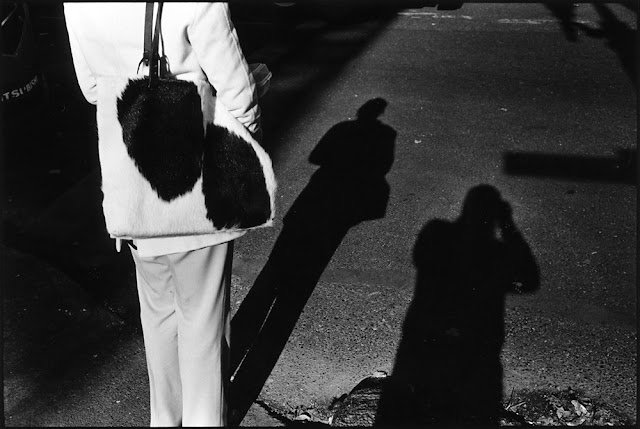
This is on the corner of SW 4th and Washington in Portland. I know the spot pretty well. There's a good Thai restaurant nearby where I sometimes eat lunch, after which I often walk by here. Usually there's nothing happening but this time a woman was standing in nice highlighting with an odd cowhide purse near our shadows. Nothing was moving, all the elements were in place, and I had plenty of time to line them up.
But I still missed the shot! Argh@#! Photos like this frustrate the hell out of me because I can't go back in time. But I will anyway. One step to the left and I could've had this.

I'm not saying the second version is brilliant. It's still missing something. But at least it's getting toward an idea. There's a relationship between the elements. If I saw this on the contact sheet I'd print it no questions asked.
It's better but I'm still not totally happy with it. If I'd waited just a moment longer I could've captured this instead.

That's right. Portland's annual Holstein 10k Roundup was happening downtown that day, and I was in perfect position to photograph it. Afternoon fall shadows were popping and the cows were out, a rare combination in Portland. A little more patience would've been rewarded. But alas, there's no going back now. That's photography.
By now you probably realize I'm pulling your leg. This isn't my photo at all. It's the famous cow photo in Michael Schmidt's Lebenschmittel, his landmark book critiquing the industrial food chain.

I've always loved his image, not to mention the book itself. Both are classics. "Stop eating cows," they prod. Or something like that. Lebenschmittel was printed in a small run which probably limited its general impact, because whether it's a book or a Holstein, it's hard to build appreciation for something that isn't widely distributed. But the citation in last year's Parr/Badger III gave it some much needed attention, and maybe even nudged it into the canon.

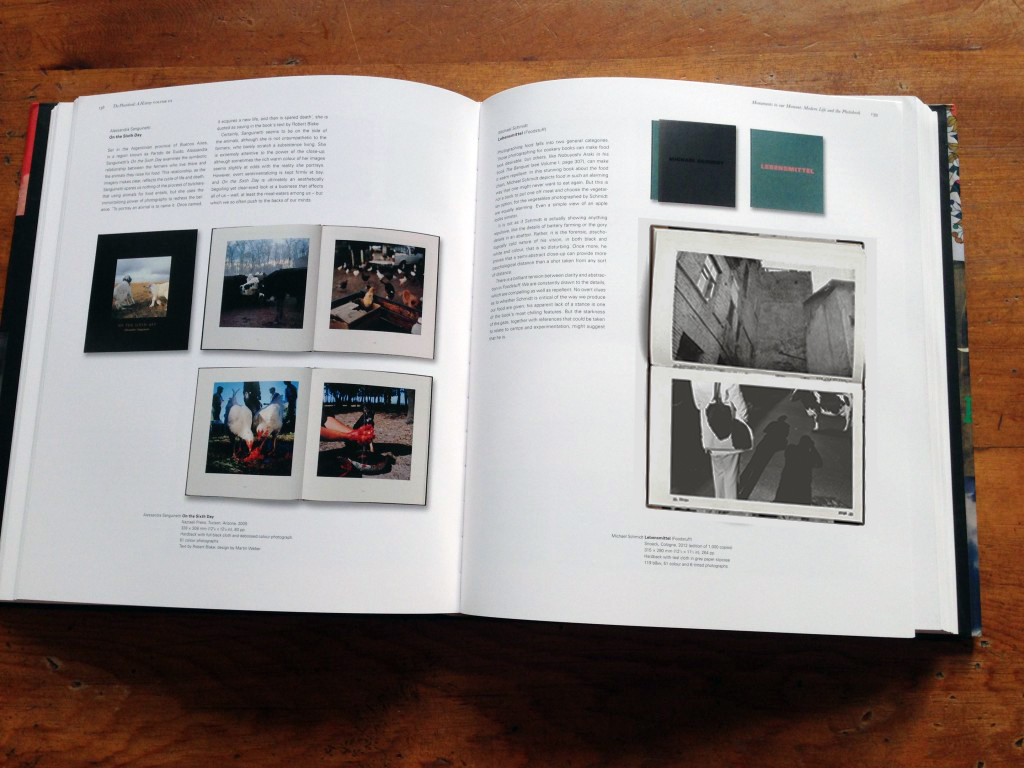
My cow photo, which I didn't take, pays homage to Schmidt's. If we were two parts of a tree his photo would be the root —No, the rhizome! — and mine would be the maple seed helicoptering on the breeze. Elements relating. But, dammit. I'm looking at this book now, or rather the photo I took of it, and I realize I got it wrong. One step to the left during exposure and I could've had this.

Photos like this frustrate the hell out of me. Oh well. There's no going back now. The moment is gone. But it's even worse, because I shouldn't have stepped left at all. A move instead back and to the right (plus a little patience) would've revealed theholstein whole scene:

This goes back to the old photo mantra. When you think you've got the photo, turn around and look behind you. That's where the cow will be. Or something like that. In this case behind you equals to the right. That version just kinda works. Don't ask me why. If I knew I'd do it every time. Something in the off kilter framing says Arty —Capital A. I think this is the type of image that could wind me in a bigtime New York gallery, if that gallery happened to have a Parr/Badger book lying open on a cherry cabinet. And if I'd taken it off center with a long shutter speed.
It's good, but it still leaves something on the table, so to speak. I think it can be improved. Looking at this image now —D0h!— the realization hits me like a brick. What I should've done is replace the ceiling bulbs with blacklights, then close all the curtains.

That's if I'd actually taken the photo. But, as I said before, I didn't. So the blacklight idea would be impractical unless I could convince the photographer I'd hired to shoot it that way. Most photographers are headstrong with their own lighting ideas, and they're especially prone to resist suggestions after you've pounded them with "Step Left! Now Wait For The Cow!" over and over. At least that's been my experience. Sigh...how many ideas have I had shot down by "Impractical"?
So, although I may have birthed the original conception for the photo —a woman standing near two shadows— by the time it hits the tabletop it's been hopelessly altered. Welcome to my world. At that point I just need to retreat to my studio and reinvision theholstein whole scene in my mind, then turn on the blacklight and wait for the pills to take effect. Under those conditions if you step left just about anything looks good. So, you know, it's hard to judge. But it's not my fault. That's what the industrial food chain does to people. When the wrong material is highlighted carnivores never think to look behind them.
Now comes the surprise. Scroll up and look at the original photo again. That's not a woman at all. That's me! I hired a photographer friend to take the shot. The same guy who shot the book. That's his shadow on the right (he had his own highlighting ideas). The purse was a thriftstore prop bought just for the 10k. So was the cow, if I'd waited.
I often wonder what Michael Schmidt truly thought of this photograph. Sadly he has passed on and it's difficult to know. But if it were somehow possible to go back in time I would ask him "Why did you use my photograph in your book?" What I really want to ask Schmidt, though —what I wonder about at 3 a.m. after the day has worn off and the race is over and all elemental relationships have been firmly established— is "Why didn't you step left and wait a moment longer?"
 By now you probably realize I'm pulling your leg. It's not itchy. It's me, this isn't my blog post at all. It's a verbatim copy of an article which caused quite a commotion when it first appeared on the front page of the LA Times in 2007 (left: highlighted yellow), Go ahead, just ask a question. I've always loved this article —it's famous for a reason— and I've been waiting for just the right moment to appropriate it. Like fine champagne it says, "Go ahead." So I've reproduced the text here word for word, but with new images and highlighting. That's what you're reading now. Some passages are yellow for easy reference. For other parts I've used blacklight. Hopefully you'll pardon the artistic liberties. Is it just coincidence that the LA Times foundered after this was published? Decide for yourself.
I suppose I could've saved some trouble by posting an image of the full article instead of writing it all out. The problem with that method is that a lot has happened since 2007. If I posted the thing as-is, it wouldn't make sense at all from a contemporary POV. FDR. CDC. PCP.
Polar bears, for one thing. And Michael Schmidt and Pope Francis. The howsing bobble, etc. But we can't go back. That's photography. Plus there are all the problems with photographing the article and stepping left or right, and ruing what might've been or not been. You walk down the street one way and you see the article highlighted in the sun. Choose the other direction and that possibility forecloses. It's the Red Sea of photography. Keep heading east. Don't look back.
4th and Washington. Why this corner, this moment, this photograph? We'll never know the real answer, and that's ok. I have my theories as I'm sure we all do. Sometimes the solution is just out there helicoptering somewhere beyond our grasp. But hey, that's photography. You can't go back.

This is on the corner of SW 4th and Washington in Portland. I know the spot pretty well. There's a good Thai restaurant nearby where I sometimes eat lunch, after which I often walk by here. Usually there's nothing happening but this time a woman was standing in nice highlighting with an odd cowhide purse near our shadows. Nothing was moving, all the elements were in place, and I had plenty of time to line them up.
But I still missed the shot! Argh@#! Photos like this frustrate the hell out of me because I can't go back in time. But I will anyway. One step to the left and I could've had this.

I'm not saying the second version is brilliant. It's still missing something. But at least it's getting toward an idea. There's a relationship between the elements. If I saw this on the contact sheet I'd print it no questions asked.
It's better but I'm still not totally happy with it. If I'd waited just a moment longer I could've captured this instead.

That's right. Portland's annual Holstein 10k Roundup was happening downtown that day, and I was in perfect position to photograph it. Afternoon fall shadows were popping and the cows were out, a rare combination in Portland. A little more patience would've been rewarded. But alas, there's no going back now. That's photography.
By now you probably realize I'm pulling your leg. This isn't my photo at all. It's the famous cow photo in Michael Schmidt's Lebenschmittel, his landmark book critiquing the industrial food chain.
I've always loved his image, not to mention the book itself. Both are classics. "Stop eating cows," they prod. Or something like that. Lebenschmittel was printed in a small run which probably limited its general impact, because whether it's a book or a Holstein, it's hard to build appreciation for something that isn't widely distributed. But the citation in last year's Parr/Badger III gave it some much needed attention, and maybe even nudged it into the canon.

Photos like this frustrate the hell out of me. Oh well. There's no going back now. The moment is gone. But it's even worse, because I shouldn't have stepped left at all. A move instead back and to the right (plus a little patience) would've revealed the

This goes back to the old photo mantra. When you think you've got the photo, turn around and look behind you. That's where the cow will be. Or something like that. In this case behind you equals to the right. That version just kinda works. Don't ask me why. If I knew I'd do it every time. Something in the off kilter framing says Arty —Capital A. I think this is the type of image that could wind me in a bigtime New York gallery, if that gallery happened to have a Parr/Badger book lying open on a cherry cabinet. And if I'd taken it off center with a long shutter speed.
It's good, but it still leaves something on the table, so to speak. I think it can be improved. Looking at this image now —D0h!— the realization hits me like a brick. What I should've done is replace the ceiling bulbs with blacklights, then close all the curtains.

That's if I'd actually taken the photo. But, as I said before, I didn't. So the blacklight idea would be impractical unless I could convince the photographer I'd hired to shoot it that way. Most photographers are headstrong with their own lighting ideas, and they're especially prone to resist suggestions after you've pounded them with "Step Left! Now Wait For The Cow!" over and over. At least that's been my experience. Sigh...how many ideas have I had shot down by "Impractical"?
So, although I may have birthed the original conception for the photo —a woman standing near two shadows— by the time it hits the tabletop it's been hopelessly altered. Welcome to my world. At that point I just need to retreat to my studio and reinvision the
Now comes the surprise. Scroll up and look at the original photo again. That's not a woman at all. That's me! I hired a photographer friend to take the shot. The same guy who shot the book. That's his shadow on the right (he had his own highlighting ideas). The purse was a thriftstore prop bought just for the 10k. So was the cow, if I'd waited.
 |
| Northern Alabama map showing Huntsville and vicinity, circa 1930s |
I often wonder what Michael Schmidt truly thought of this photograph. Sadly he has passed on and it's difficult to know. But if it were somehow possible to go back in time I would ask him "Why did you use my photograph in your book?" What I really want to ask Schmidt, though —what I wonder about at 3 a.m. after the day has worn off and the race is over and all elemental relationships have been firmly established— is "Why didn't you step left and wait a moment longer?"

I suppose I could've saved some trouble by posting an image of the full article instead of writing it all out. The problem with that method is that a lot has happened since 2007. If I posted the thing as-is, it wouldn't make sense at all from a contemporary POV. FDR. CDC. PCP.
Polar bears, for one thing. And Michael Schmidt and Pope Francis. The howsing bobble, etc. But we can't go back. That's photography. Plus there are all the problems with photographing the article and stepping left or right, and ruing what might've been or not been. You walk down the street one way and you see the article highlighted in the sun. Choose the other direction and that possibility forecloses. It's the Red Sea of photography. Keep heading east. Don't look back.
4th and Washington. Why this corner, this moment, this photograph? We'll never know the real answer, and that's ok. I have my theories as I'm sure we all do. Sometimes the solution is just out there helicoptering somewhere beyond our grasp. But hey, that's photography. You can't go back.


