Matt Weber is a photographer based in New York City.
 What does the title More Than The Rainbow refer to?
There was also a knife called the 007 which was large and cost a bit more in the same shops. It had a larger blade and was more imposing. The standard line was "Your money or your life?" and it does seem comical all these years later.
Fortunately guns were far more scarce, and kids knew who had one, but rarely owned their own. Also the standard gun was the "Saturday night special" a cheap .38 caliber and there were also tiny .32's around. I never owned a gun and dislike them very much, having had them pressed up against many different parts of my body!
My mother decided when she was almost forty that being a house wife wasn't cutting it for her anymore. She had been an actress and even starred in an Arthur Miller play on Broadway when she was 18 years old! She went back to school and became a playwright. One of her early plays made it to Broadway and she recently converted the book "Giant" by Edna Ferber into a musical. My stepdad was working on Madison Ave. during the "Mad Men" era and was involved in the famous advertising campaign for Tareyton cigarettes, the one which said: "I'd rather fight than switch" and all the people had black eyes from fighting for their favorite smoke. He later became a consultant for the United Nations and many other companies.
Harlem is also 99% gentrified so there's not too much of interest left for me. I have to admit to liking very old stuff and that is becoming very scarce in New York. Times Square is great at night since there's a lot of light and I hate using a flash. I should push myself into the Bronx since it's one of the last places which hasn't been purified, but you can get into trouble if you just shoot with abandon up there. I don't like asking for posed portraits.

I'm putting the dates together. You went to music and art school in 1972, the same year you stopped doing photography. So the school didn't focus on photography as an outlet? Or am I wrong? And did you study music there too?
•
BA: I just watched your movie More Than The Rainbow which I really enjoyed. Can you tell me how the film came about?
MW: My friend Dan had a friend Arlene who is a very gifted cinematographer and he asked her if making a movie about me interested her, and she said sure! Then he asked me and I don't believe in turning down opportunities, since they can few and far apart.
What does the title More Than The Rainbow refer to?
Just a line from the film where I'm saying I needed more than the rainbow to be happy with a black and white picture I had taken, of a rainbow.
Are you generally happy with the film?
I have learned to deal with criticism and think that the film is pretty outstanding because if you gave 100 editors the same pile of footage and images, they'd make 100 different films. I doubt many would do as well.
What happens to the film now? Will I see it in theaters, or is the distribution end of it unsettled?
It did well in festivals, but I think after the DVD sales slow down, streaming is probably the best avenue. I bet you know more than I do about this stuff. Theaters don't like crowds of thirteen people and I saw the Vivian Maier film with about six people in Manhattan.
How did the variety of other photographers get involved in the film? Zoe Strauss? Mermelstein? Jeff Ladd? Ben Lifson? Was that through you or the film makers? And how did you decide who to include?
Good question. I wanted Zoe, but then again everybody does! Jeff Mermelstein used to live a few blocks away from me and we'd bump into each other often just walking around the upper west side. He was nice and agreed to talk about photography at the local diner, and I think his contribution was very important to anyone who cares about street photography. I met Jeff Ladd and became a huge fan of his Errata books. It was a brilliant idea to republish these classic photo books which had become too expensive for mere mortals to afford. Ben Lifson had done the intro to my book and we were obviously very happy to have him aboard. I knew Boogie and obviously was good pals with Dave Beckerman. The rest were recruited by the producer. We had asked for a few other very established photographers, but they declined having just been filmed in Everybody Street, which was a film that we did not know about at the time.
Why do you think Arlene was drawn to you as a subject?
She had seen my apartment and also I guess I babble in person a lot about all the crazy stuff I did as a younger guy. Of course most of my war stories didn't make it into the film, mostly to protect my daughter!
 |
| Matt Weber in a still frame from More Than The Rainbow |
Your daughter doesn't know your past?
She's starting to get much of it and it's a bit uncomfortable. Mostly stuff that was not legal when I was a teenager.
Did you ax murder someone? Or mostly teen hijinks?
Subterranean stuff with spray paint and psychedelics. Never mugged or stole anything as I did have principles. I even paid for my spray paint which was considered very lame.
That's interesting because the movie was mostly about photography. I enjoyed your comments and the range of other photographers in the film. But I didn't learn much about your war stories or even know that's why the film was made.
I guess Dan did what he felt was best and I think he thought the crazy stuff from my youth was off topic.
Graffiti? Drugs? Pretty harmless in moderate amounts.
Not moderate at all. We were the east coast pranksters and I'm not exaggerating at all.
What type of pranks?
I meant pranksters like Kesey. I might as well have grown up in a never ending Woodstock festival.
Your folks were hippies? The sixties scene?
No, they were and are very liberal but they kept away from total immersion into the scene. I fell into it heavily when I was fifteen. The sixties sorta lasted until 1977.
I wish some of those stories had made it into the film. I think most people hit a stage like that in adolescence. Maybe 15 is younger than most. This was in New York? Which part?
Dead center...Central Park.
Where did you live exactly? What was the neighborhood like?
I didn't live near Central Park but it wasn't very far either. The upper west side was mostly middle class and lower middle class, with a few wealthy people living on Central Park West and Riverside drive. There were also and still are quite a few housing projects which date back to the late 1950s. Robert Moses and his social experiment has been plaguing New York City for a very long time. There were plenty of empty lots to play in, and also the street lights weren't as bright, leaving the streets much darker and dangerous. Anyone who lived here in the sixties and seventies will remember what it was like to have to keep your eyes open at all times. Getting mugged was part of life, and one learned which streets were less likely to leave you penniless. It varied from block to block.
Were you mugged?
I wonder how to express the effect that being mugged several times had on me growing up. I was lucky that most of the kids who mugged me were local and didn't want to hurt me bad enough to warrant police reports. They just wanted my loose change of maybe the lone dollar bill I might have had. The normal weapon was a cheap knife called a K-55 sold in Times Sq gift shops for around $1.25 or so. They were certainly made in Japan and were replicas of a more expensive and well known weapon.
 |
| Image courtesy of Matt Weber |
There was also a knife called the 007 which was large and cost a bit more in the same shops. It had a larger blade and was more imposing. The standard line was "Your money or your life?" and it does seem comical all these years later.
One time I was riding my brand new 15 speed bike through Central Park late at night and I was alone. Suddenly I felt woozy and realized I was lying down. In the distance I saw the guy who punched me in the head and took my bike, riding away. As I said before, the old street lights were very dim compared to today's, and I never saw the guy coming out of the bushes.
 |
| Image courtesy of Matt Weber |
Fortunately guns were far more scarce, and kids knew who had one, but rarely owned their own. Also the standard gun was the "Saturday night special" a cheap .38 caliber and there were also tiny .32's around. I never owned a gun and dislike them very much, having had them pressed up against many different parts of my body!
Later in my cab I had the experience of being held up at "Double Gunpoint" which was the worst thing I ever had to experience! These two Chinese kids got into my cab at 2am and asked to go to Queens. On a dark residential street I pulled over thinking I was about to get paid for the ride, and I felt something against my neck. It was an automatic pistol, and his friend climbed over the front seat (I had no partition at the time) and he had a standard six shot revolver which he shoved into my then slim belly. Feeling nervous the guns were trembling almost much as I was. When they ordered me to get out of the cab, I literally hurdled the hedges on someone's front lawn like Rafer Johnson. I didn't hear a gunshot and they drove off in my Crown Vic. I realized later how lucky I was that one of them knew how to drive, since it made it unnecessary to shoot me…That was in November of 1984, a couple of weeks before I bought my first Canon AE-1 and started photographing New York! Had either teen pulled his trigger, most likely there'd be nothing for us to discuss.
What did your parents do for work?
 |
| Tareyton Cigarette Ad |
Any siblings? Religion? Ancestry?
I have a younger brother who is a musician and recently I became an uncle to his son. My parents never forced religion on me and I think I'm OK without religion. I could talk pros and cons for hours but that would be way off topic. My ancestry is very complicated. I am actually able to trace my lineage back to the Mayflower on my father's side and my mom's family was totally changed by Hitler and WWII. She was lucky enough to escape Germany in 1937 and the rest of the story is long and complicated. The movie Valkyrie starring Tom Cruise covered parts of it.
When did you start driving a cab?
The cab was my exit from the "scene". Many of the older guys I looked up to had become strung out on smack and I saw the writing on the wall, so to speak. Cab driving was an excellent job in 1978. $100 a day was a lot of cash. One bedroom apartments were still $200 in Manhattan! I have a pal who's been working on a doc about the scene and even has DA Pennebaker helping him, but I doubt it will ever get finished.
You mention your friends getting into smack. What was your experience with heroin?
I lost my father to heroin in the '60s and only met him once. A guy who was my best friend during my graffiti writing days later got strung out and also ODed. I lost many others friends from overdoses and or AIDS, and was able to keep my promise to my mom to never touch the drug. Considering the way things worked out for so many of my friends, I made a good choice to keep my word.
The filmmakers followed you around to a few places while you photographed and talked. It made me curious about your shooting process. How do you decide where and when to go to which areas?
When I had a taxi I hit literally every single street in the whole town. Coney Island was important since I had a couple of birthday parties there in the '60s. I wish I had shot a lot more there in the '80s but I'm glad I did shoot a few rolls. In 2003 there were Donald Trump rumors about casinos and giant 40 story hotels coming and that everything would be torn down. I started shooting a lot there and now I am winding down because the transformation is almost complete.
But you shoot more than just Coney Island, right? Or has that been your focus lately?
 |
So it sounds like you limit yourself to certain areas. And Coney Island is one?
I guess I have concentrated on Coney and the Subway. It is time to branch out a bit. It's easier to shoot a neighborhood when you live there. If you have a kid to deal with everyday at 3:30 when they come home from school, you have smaller windows of time to go and shoot. Sometimes my only trips are to B&H and I get a decent amount of pictures on 34th Street.
You made a Coney Island book with Mike Peters, right?
Yes, the Mike Peters Coney book is just available on Blurb and sold a whopping thirteen copies. I actually feel very good about that book and think it's a good concept...
Some of the pairings seem beyond coincidental. How did you two go about editing that?
I left all the editing up to Mike. I told you before that I am fine with seeing what other people do with my pictures, if I like the pictures enough to publish them in the first place. I have an absurd amount of pictures from Coney scanned and ready to print. Same with the subway. Finding a bona fide publisher has become pretty hard these days, although I haven't made much of an effort. I am a lousy businessman.
 |
| from Coney Island Double Vision, Matt Weber and Mike Peters |
Do you see Mike Peters often? Is he a close photo buddy?
Mike is a good pal and I don't see him as much as I'd like because he has a full time job shooting for a college in Jersey. I don't like shooting with people. It is usually a drag and I love talking and hanging out, but shooting is a solitary process for me.
What's your actual process? How do you deal with film? Do you have a darkroom? Do you shoot any digital?
Well it's almost hard to admit that I have begun my digital phase. I love film and its superior range. I fell in love with Kodak's Portra 800 but at $11 a roll and $6 for a dip & dunk, the cost is now out of my range. If I shoot six or seven rolls in a day, that's $100! I know junkies who have cheaper habits...I have a full B&W darkroom and I should go back and make a few editions of some of my more important pictures while I still can, or before the supplies are too expensive.
So no more film? All digital now?
I have been shooting digital for the past few months. I blame Mike Peters who did great work with a Hasselblad and then went fully digital. He helped me with the transition. I admit that are now a handful of images which I wouldn't have gotten with film, but also a few that film would have been much better at...
I understand it's expensive and the reasons behind going digital. But surely there are other feelings involved too. How do you feel about film and digital in artistic terms? Did you have some special relationship to film? Or no attachment?
At first I was actually embarrassed about abandoning film. I love Tri-X as much as you do! I love a perfectly developed negative. I know that the most important thing is the image itself, but the tones and the extended range which a properly developed negative has, is priceless.
High speed color film sucked until recently. Twenty or thirty years ago the 800 chromes or the 1000 ASA C-41 was grainy junk with terrible colors. Now however, the Kodak Portra-800 is an amazing film and I wish I could just keep shooting as much of it as I'd like. It just isn't in my budget!
I am slowly but surely adjusting to the terrible viewfinder of the GH3. I say that because after shooting with a Leica rangefinder for fifteen years, the GH3 can't compare. The good news is that I am starting to take a few images which I think I would have missed if I was still shooting film. Despite Garry Winogrand's famous line "There are no pictures while I reload" there are plenty! I have missed many images when the roll runs out. Its not worth discussing it's so obvious. At least if I keep an eye on the battery power, I can usually shoot to my heart's content. I have yet to see how wonderful my digital images will look when printed, but hopefully
they will be OK.
How much film would you estimate is in your archives?
I guess I have shot around 10,000 rolls of film, and I'm not sure if that's a lot, but it's enough to keep me busy for the rest of my life! Every time I go back to my loose leafs full of negs, I find new ones I never printed or scanned. The new ones are very rewarding, and I know that I will never have that experience with digital, but I also think I edit my work differently these days. It takes a lot more to satisfy me and that is a good thing...I could go on and on, but enough said.
What do you look for on the street?
On the street I just keep my eyes open. I see motion and emotion. That's my 2¢...I wish I saw as many things as you do inside the viewfinder but I guess I just wait and pounce.
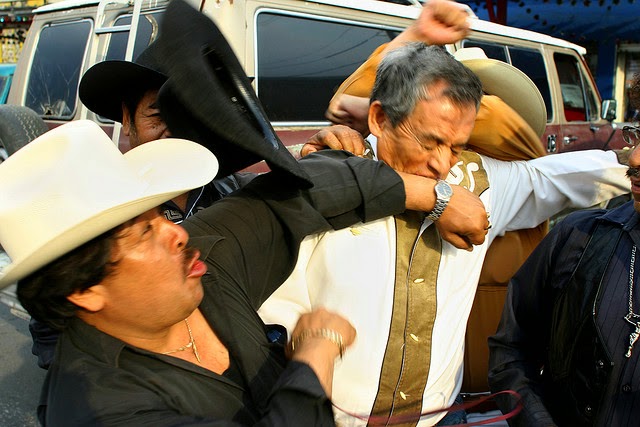
You seem to have a lot of photos of fights. I don't know if that's conscious or not but maybe they attract you? Or tension attracts you?

Well, I have over 150 fight snaps in a folder so a book would be easy to lay out. I grew up with a best friend who became a boxer and he's always slapped me upside my head. Maybe all the slap boxing is still in my psyche, I don't know. I just love freezing action.
Are you planning a book of the Fight photos?
I'm dreaming of at least five more books. That's not a lot when you consider the amount of pictures I've taken. The "Fight book" would certainly be one which would get handled by the teenagers at Barnes & Noble. It would be hard for me to explain its importance to a normal publisher, but hopefully one who understands photography would see the book as one which would be very unique.
The film made reference to a New York photo club of some sort. With Dave Beckerman? What's that about?
I like meeting photographers. No club I'm part of. I use to bump into Jeff Mermelstein since he lived in my neighborhood. I hired Beckerman in 2005 to shoot some pics of me and my kid at the zoo. I had almost no pictures of myself and thought it would a good investment. Dave is the quintessential New Yorker in the classic sense. He grew up in the Bronx of the1950s and has countless stories which he should write about!
So you don't have others to share work prints with in NY? Is most of your feedback and interactions online?
Online photography is weird. It gets kind of depressing sometimes as I see a lot of silly squabbles erupt between photographers. There's way too much to sift through so I really don't look at very much work these days. Beckerman is pretty amazing in the sense that he almost never looks at other people's work.
I guess not looking at other work cuts both ways. You don't contaminate your vision, but you don't expose yourself to a lot of new ideas either.
Who buys your work mostly? Photography buffs? Or people into New York scenes? Or others?
I find mostly my older images get purchased for documentary uses.
So when someone orders an older print, that's when you go back to the darkroom? Or you have extras printed for most of them already?
The market is very strange. I wonder what the angle is that I haven't tried.
I'm the wrong person to answer that.
I have become reticent to sell my better silver prints. So much work went into making them and many are on papers which no longer exist, like Agfa Portriga which was a beautiful paper. I just bring my Imacon scans which are pretty good to a local lab and let them print them for me. Then sign them and ship them in a tube. Its simple but my prices are way too low.
Beckerman helped me with the new site which does need an overhaul. Markus Hartel is going to publish a digital version of my book for iPad users on iTunes. I think it'll sell for $7.
You're going for many different distribution points it seems. I guess that's what it takes. I don't really enjoy looking at books on a screen but that's just me. Personal preference.
Have you ever shot outside NY?
I always shoot when I get out of the city...Only made it out to California once in 1992. That was a nice thing to do. I shot 53 rolls in 30 days and thought that I had been productive! I would shoot a lot more if I ever did it again...
53 rolls is small?
53 rolls in a month traveling to places where you're never going to be again, is a paltry amount I think. When one is young I think everything seems to be less urgent...I always wish I had shot more back in the "days".

I have a large library and at this point in time, my daughter seems to have no interest in my books. The photobook scene is also a bit out of hand. Wall Street money made many titles unaffordable and there are 100s of new books being self published all the time which is nice, but impossible to keep up with...
Which 5 would you take to a desert island?
I hate to seem so fucking predictable but The Americans is probably the first book I'd grab off a sinking ship. American Photographs by Walker Evans....Szarkowski's Wino book, Figments From The Real World. The Decisive Moment (Original edition). Very hard to pick the fifth book. Number five might have to be a large retrospective on W Eugene Smith.
You mention Figments. Have you seen the new Winogrand book? Or the show at the Met?
Of course I bought the book, and saw the show twice. It's always nice to see a few new pictures from someone that you're so familiar with.
But you'd still take Figments instead? So it sounds like the new edit didn't add to your appreciation?
Winogrand's 1964 exhibit was very satisfying as was the book!
That book is great. He was peaking in the mid 60s. Seeing well.
The new book wasn't printed all that well. Figments was a better edit I think. After all Szarkowski did the book. I still enjoyed the new snaps a lot. I'd like to think that I was at the zoo while he was taking those epic pictures. My grandma took me there all the time in '64.
Were you the kid doing the somersault on the railing? No, just kidding. I think that was Ethan Winogrand.
 |
| A young Matt Weber?, Garry Winogrand |
I was there but my grandma was taking blurry pictures of me with her Kodak Retina. I still have that camera. I wish she had a Leica since she was German...
Was she an active photographer?
No, she was awful but tried constantly to document me. I shot with her camera in the late 60s and up until '72 and then stopped for 12 years. From 1972-1984 I shot one roll of film. I regret that!
What age were you then and why did you stop?
I was 15 and started hanging out with people who did not like cameras. I saw so much crazy stuff that it really is painful to think of what might have been.
The Central Park years you mentioned earlier. But of course you can't regret that. If you'd photographed it, the whole experience might have been altered in some fundamental way. Photography has a tendency to do that. I never photographed much of anything until age 24. There was a lot of teen stuff before that which would've made great photos. But it was fun anyway. Maybe funner.
True, but I saw historical stuff which wasn't documented very much and I tend to worry about the ones I missed. There are a handful of images seared into my brain which I missed for various reasons. They often haunt me...You must have one or two that you know woulda been epic, right?
Yes I've missed plenty but nothing historical. I usually stew over missed shots for an hour or two. Occasionally they will get in my head enough to create problems shooting, but after a few days I forget. Can't remember any as I write this. What history are you talking about?
August 6th 1989 I left my house to go to Jersey and a BBQ. At midnight I was dropping off a friend in the east village and the Tompkins Sq. Park riot had just begun. I had no camera and there was a lot of blood. I watched a cop in riot gear just destroy some poor guy who was begging for mercy. The cop had his big visor on and the billy club just kept crashing down on the guy. I was in the safety of my cab and with NO camera! The next night on the news I saw myself on TV staring at the same guy being beaten!
You didn't carry a camera with you in the cab?
I decided not to on that one night. Just to enjoy my friend's company! Murphy's law in effect I guess. I learned my lesson...I never left home again without a camera!
Did you shoot many photos while on cab duty?

Yes, I shot constantly. A 50mm and a 200mm since I was stuck in the car.
How does shooting from a cab differ from shooting on foot? Could you actually see stuff as you drove by? Or just during stops?
I'm the best driver I know, or at least I was. I shoot through the windshield and windows on the highways and streets. I got good at shooting people at night since 3200 TMax had just hit the market in '88...It took a few years to relearn how to shoot on the street without the cab. I finally figured it out around the year 2000.
I have a camera with me in the car always. But it is usually difficult to get good photos. If I see something really tasty I need to look for a parking place and by then the moment has passed. Freeway shooting is easier for me. But less good subject matter.
Why do you mention the years 72-84 as nonshooting. I know you resumed shooting after 1984. But were you taking photos before 1972. As a young kid?
Yes, from '68-'72 it was a hobby and I shot mostly Tri-X and a few rolls of Kodachrome The Extachrome and Agfachrom and also the Anscochrome slides all faded badly to pink. I sold this one (below) twice recently!
Wow! Not bad for a 14 year old. And you were a painter too? So you were an artsy kid from an early age. What's the film Across 110th St.? I guess I should look it up.
Anthony Quinn and it's not an incredible film but if you like old NYC footage then it's worth it. A lot of heroin and dirty cops in the movie...
Why did you get into photography as a 10 year old? I suppose I should've asked that question way back at the beginning. You took up photography at 10 and had an art tutor at 14. Was that coming from your folks? Or were you a young prodigy?
I don't think I was that talented but I wanted to paint and then when I went to Music and Art high school up in Harlem in 1972 I met some other guys who were starting to write graffiti. I went from oil painting to spray painting which is something I probably shouldn't have done.
I just heard a long interview with Shepard Fairey. It was NY graffiti which inspired him to become an artist. He did graffiti for a while then graphic design, RISD, etc, and the rest is history. Just saying, graffiti has a tradition and a place in the art world. I mean, think of fucking Banksy...
But painting came after photography for you, right? Why did you start in photography? What was going through your child brain?
Painting was something which I think made me parents happy. It was certainly an art and photography seemed like a hobby in those days. There are a handful of guys who I wrote with, that have become very famous...
You were a writer too?
No, I tried but nothing to speak of.
 |
| Matt Weber with Kodak 126 Instamatic, Circa 1970, Photographer Unknown |
I'm putting the dates together. You went to music and art school in 1972, the same year you stopped doing photography. So the school didn't focus on photography as an outlet? Or am I wrong? And did you study music there too?
No just art and academics. I dropped out in '74 which was another bad move. In 1975 I took a photography course in black and white but I didn't get excited and never pursued it. That does bother me!
Did you finish high school somewhere else?
Not really, I just begged them to let me take the G.E.D test at 17 which was one year early, and I passed it so I got a bullshit fake diploma...
It amounts to the same thing. I've got a diploma but it's not like it has any bearing on my daily life. My photos would look exactly the same regardless of any paper forms.
Some photographers swear by their mentors who taught them. Being self taught I wonder what my pictures would be like if I had had a brilliant teacher...
They'd look like the teacher's photos. Maybe.That's the Beckerman philosophy right? There are many paths. No right or wrong way to make pictures.
I agree, but would hate to be trying to emulate someone else.
What do you think your photos are mostly about? Do they express what you've seen and recorded? Or do you think they are more about New York and documenting historic scenes? Or some combination?
I like to think they are about everything. I know that is not a great answer, but I have been trying to make interesting pictures of every type I can possibly find out on the street. Happy, sad, funny, somber, landscapes, subways, nights, lovers and of course Coney Island.
You seem to live in the past a bit. Several times in the discussion you've expressed regret for certain actions or lack of them. And your photos harken back to an earlier age in their style. Is that just a photographic thing? Do all of us photographers look in the rear view mirror by necessity?
It's true that I have some regrets. I am very happy that I took the pictures I did, but life is short and things change in this town very rapidly. I spent countless hours trying to unwind from the stress of driving a taxi seven days a week by watching Yankee games. As if Don Mattingly's next at bat was of great national importance. There was this crazy city, and yes I shot a lot of film, but I wish I had shot more. You only get one crack at this. Walker Evans spent a lot of his energy capturing what was left of the nineteenth century. I loved his work, but I'm not sure why my approach was similar. I was able to find quite a bit from his time that the wrecking ball had yet to destroy. I loved the old city and its signage was still to be seen in a few of the poorer neighborhoods. Harlem was still Harlem, and the lower east side was a disaster zone. "Alphabet City" was as bad as just about any part of New York and I had some hairy moments in my cab trying to avoid being robbed. The city looked like a war zone in many places and I suppose that's a good thing photographically. Maybe not.
Every photographer becomes aware of there fact that his camera is a virtual time machine. After a few years, you start looking at negatives or images of people who are either dead, or look much older. Kids are grown up and the elders are gone. The buildings which were just part of the background are all of a sudden historical artifacts. It really does happen in every city I'm sure.
Where do you see yourself in 5 years? Or 10?
I have said this countless times and I don't think it's a lot to ask. I would like to sell enough images or prints to pay my bills. There was never any doubt that I was doing this for reasons that had nothing to do with money, but life in New York is becoming absurdly expensive and I would love to stop living month to month. I've been scraping by since I moved out in 1975 as a seventeen year old drop out. A friend of mine recently said something rather astute. He said "We were the last generation that would be able to skate through life, just on our wits." Now one must be completely bona fide if they think they can thrive in New York. High school drop outs need not apply.
(All photos above by Matt Weber unless otherwise noted)