Street photography has swelled in popularity in recent years, and with its rise has come a slew of sites promoting the form. A notable example is Cedar Pasori's recently published
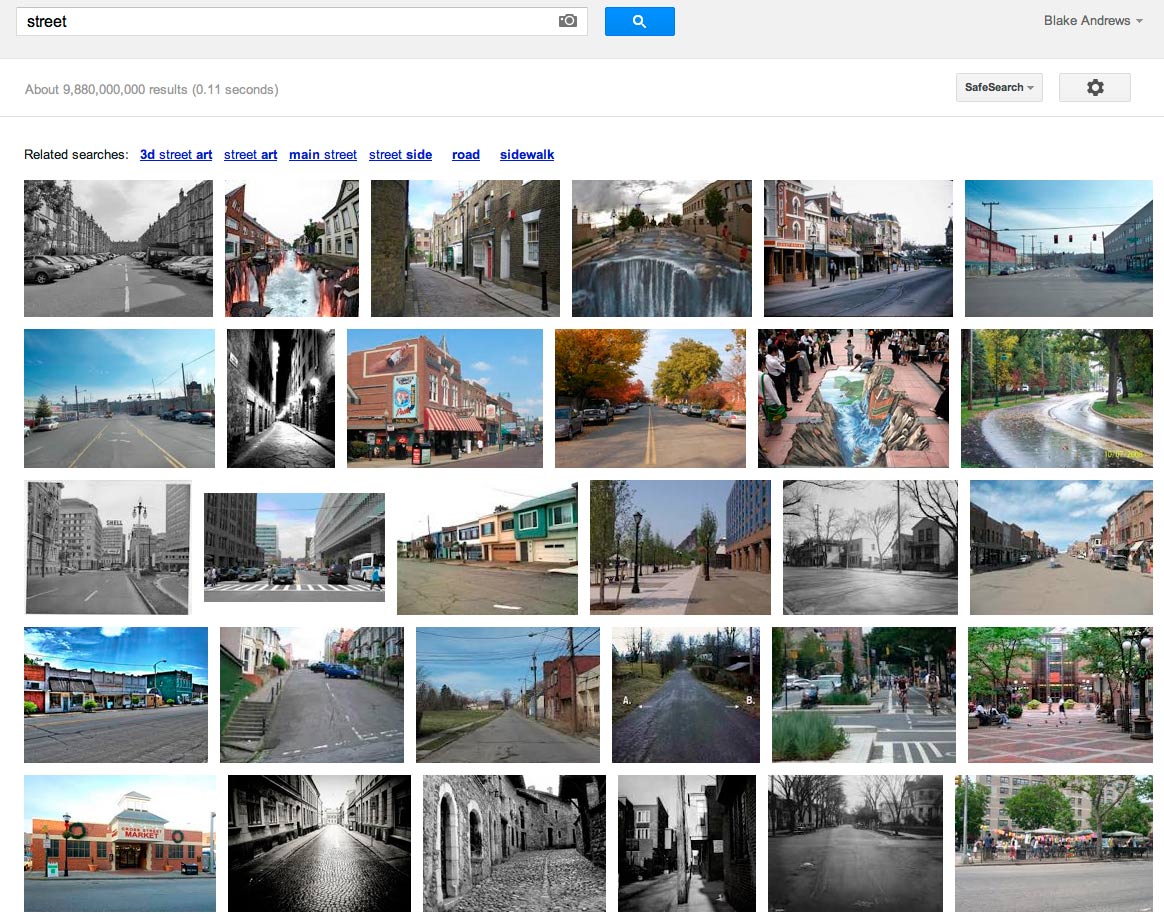
50 Greatest Street Photographers Right Now. This article is well timed, since street photography has slipped into a period of dangerous fragmentation. There are so many possible approaches and techniques that it can be hard for the interested viewer to know where to start. A simple Google Image Search for "Street", for example, reveals a multitude of possibilities within only the first 30 images. And that's just the tip of the iceberg.
 Google Image Search "Street"
Thankfully,
The 50 Greatest Street Photographers Right Now delivers just what the title promises. It cuts through the clutter, encapsulating a state of the art summation of street photography today. As a longtime street shooter I find the selections fascinating. What elevates a photographer into the pantheon of The 50 Greatest? Obviously they share a love of streets —
Street, to use the photographer's term. But what more can we learn? What are their techniques? Their hopes? Their dreams? Their influences and antecedents?
Pasori has cleverly incorporated
Street into the very structure of the list by remaining receptive to luck, chance, and the happy accident in finalizing his selections. To the extent that many of the choices leave the viewer scratching his or her head, that sense of mystery only reinforces the serendipitous nature of
Street.
Street cannot be bottled up and explained.
Street is impetuous.
Street is unplanned.
Some of The 50 Greatest show the street in Platonic terms as a visual extension of what a street can be. In the photo below Moby depicts the street from a central vantage point, using the center line to divide the image symmetrically. The palm trees and lack of pedestrians complement the idealized theme. Ask a child to draw his perfect image of what
Street looks like and one might get something like this. Assuming the child was standing in the middle of an empty street in Miami. Or perhaps examining the shadow of
Street on a cave wall.
 from The 50 Greatest Street Photographers Right Now, Moby
Moby's photo directly references the earlier work of well known street photographer Thomas Struth, whose vision of 6th Avenue in Manhattan pioneered the symmetrical street motif.
 6th Ave and 50th, New York, 1978, Thomas Struth
Julian Berman's photo below follows a similar strategy. He too depicts the street from a fantasized perspective. But there are a few key differences. Unlike Struth and Moby, Berman has chosen to shoot from the street's shoulder, throwing the viewer deliciously off balance. Instead of palm trees or skyscrapers, Berman uses the distant sea to play a background role. If "good dreaming is what leads to good photographs,” (according to the Wayne Miller quote) this is a street of dreams. If your dream had a distant parked car in it.
 from The 50 Greatest Street Photographers Right Now, Julian Berman
Berman's image takes its cue from the classic dream-like work of street master Gregory Crewdson, one of the first photographers to fully explore the parked-car-in-street motif.
 from Twilight series, 2002, Gregory Crewdson
Failure is a constant in
Street which must be overcome. 99% of the streets we walk down will have no parked cars, no men standing in the rain. That Crewdson found such a scene —Perhaps after days or months of pounding the pavement in search of something he could only imagine— is a tribute to the perseverance of him and all street photographers. We might be tempted to chalk up such discoveries to luck, if it weren't for Crewdson's uncanny ability to find such scenes over and over again.
 Untitled (Brief Encounter), 2006, Gregory Crewdson
Moby, Berman, and Crewdson pay deliberate homage to street photography's very early history as well. The viewer is reminded of this photograph by street photo pioneer Roger Fenton, which explores the same themes of the void, the open road, and the beckoning passage.
 Valley of the Shadow of Death, 1855, Roger Fenton
In contrast to these serene vistas, Liam McHenry's street scene (below) is decidedly gritty. McHenry lifts the veil of fantasy. Now we are in the real world, a world of trash receptacles delightfully ascending in a row, each with a splash of fuschia. This is the type of thing most people walk by without noticing. Look at the woman now, walking by. Only the heightened visual powers of a dedicated street photographer notices the trash buckets. Only they can bring them to our attention. In this case the result is an image so powerful we can almost smell the cans.
 from The 50 Greatest Street Photographers Right Now, Liam McHenry
Whereas others might take the definition of
Street for granted, Johnny De Guzman isn't satisfied. Most street photographers look across. He looks up. His highway interchange photo below questions the very nature of street. What separates a street from other forms like a highway or a road? What separates an avenue from a boulevard? A parkway from a thoroughfare? A smile from a veil? Do you think you can tell? Can the "roads" shown in the photo even be called streets? Guzman's photo represents the height of street and/or road and/or avenue photography. It's about 46 feet tall by my estimate.
 from The 50 Greatest Street Photographers Right Now, Johnny De Guzman
Again this photograph honors its street predecessors, in this case the prolific street shooter Ansel Adams. One of the mantras of street shooting practiced by Adams is that
Street can happen anywhere. It can happen in a national park, near a waterfall, near Half Dome. Wherever there are streets it can happen. For
Street isn't just a place for cars to drive.
Street is a state of mind. And when that state occurs the street photographer is ready to pounce.
 Freeway Interchange, Los Angeles, 1967, Ansel Adams
I think the subject below might qualify as more of an avenue than a street. Maybe "promenade"? I guess it's all a matter of semantics. But then again there's no such thing as a "promenade photographer", right? Only
Street has the pedigree which can properly encompass such a vantage. The viewer is left to contemplate what those long white lines are. Cracks in an underground volcano? Mayfair streamers? Or maybe just reflective chalk drawings left by an innocent child, wise beyond his years.
 from The 50 Greatest Street Photographers Right Now, Wittner Fabrice
The practitioners shown thus far have followed a traditional route, shooting at a remove in order to more easily codify and objectify the whole. But some street shooters take the opposite approach. In the photo below (from his eponymous
Street series "Down These Mean Streets"), Will Steacy zeroes in on the mean street at close range. One can almost smell the nicotine tar on the breath of the street in this photo as the form of discarded butts mimics a hundred exhaust mufflers. But discarded butts only hint at the eternal street mystery. Whatever happened during the first half of those cigarettes is left to imagination.
 from The 50 Greatest Street Photographers Right Now, Will Steacy
Terry Richardson shoots from a similar perspective, reminding the viewer in spectacular fashion of the Erwitt quote, “All the technique in the world doesn’t compensate for the inability to notice."
 from The 50 Greatest Street Photographers Right Now, Terry Richardson
Boogie takes the same approach. He knows that nothing is as mysterious as a fact clearly described.
 from The 50 Greatest Street Photographers Right Now, Boogie
I suppose the above photos might be more strictly classified as
Pavement than
Street. Again it's a matter of semantics, yet materially inseparable from the essence of
Street. For what is a street without pavement? Might it look something like Yanidel's photograph below?
 from The 50 Greatest Street Photographers Right Now, Yanidel
In one simple photo he raises a million possibilities. No longer must a street be paved. It can be cobblestone. Dirt. Asphalt. It can be mostly cobblestone with little bits of asphalt smoothing the uneven spots, like butter spread on French baguette. Like that baguette, or any bread really, especially when it's pointed upward like a mighty phallus, it can rise like the Arc de Triomphe.
Or it can wallow in the gutter, as in this photo by Andre Kertesz. Look at the photograph below and be reminded that photographs don't lie. Photographers lie. Some famous photographer said that and it's true, which is sort of a paradox if you think about it, like the paradox of cobblestone juxtaposed with pavement. Or Malroux juxtaposed with Malkmus.
 Paris, 1929, Andre Kertesz
Another photographer working at close range is Andre Baumecke. His photo below explores pavement graphically. The thick white lines of the crossing pattern are mimicked by the thick white borders he adds to his images. The border is difficult to see here against the white background, but it is there. It is the void. Speaking of white hats, "hunters aren't cooks," said Henri Cartier-Bresson. Think about that tonight, young street
sous shooter, before you dream.
 from The 50 Greatest Street Photographers Right Now, Andre Baumecke
Baumecke isn't the only street photographer to address the issue of walking. Jana & JS have also branched out into sidewalk work, as in the photo below. Many streets are bordered by sidewalks. Sometimes these sidewalks have feet on them. Sometimes, if the photographer is perched at the right place and time, with camera artfully cocked askew, ready to pounce, those sidewalks can create magic.
 from The 50 Greatest Street Photographers Right Now, Jana & JS
Of course sidewalks aren't the only boundary structures found near streets. The simple parking lot is another. In the photo below, Dylan Kasson explores some of the similarities. It's paved. It has lines. Cars drive there. Why can't a lot be considered a form of
Street? Kasson's photograph punches right through that question with the drive and spirit of an Indy car doing donuts in a parking lot. What is
Street? Consider the definition expanded, because we've just added another lane. Aww Yeah.
 from The 50 Greatest Street Photographers Right Now, Dylan Kasson
Zane&Inzane provide another example. As with Kasson's photograph a lone shopping cart is depicted in the lot. Perhaps it represents consumer culture? Or dare we allow ourselves to imagine something more sinister? A cage? The prison walls we mentally construct while driving down the "street"? The viewer is left to wonder.
 from The 50 Greatest Street Photographers Right Now, Zane & Inzane
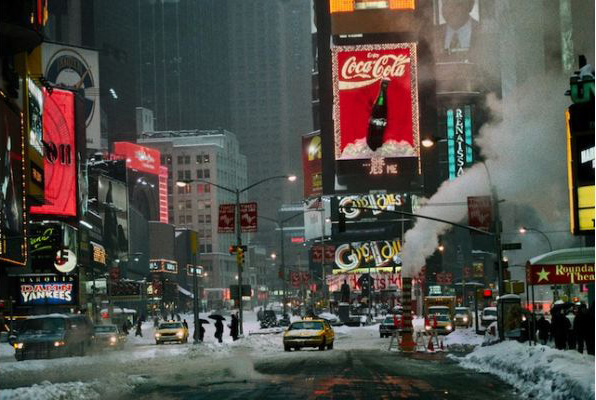
Whereas the photographers mentioned thus far prefer the placid vernacular of simple form, Steve McCurry chooses to show the street filled with material. Billboards, cars, pedestrians, snow, The Yankees…Every element has its place in the chiaroscuro. The effect is similar to a manmade Japanese Garden. Remove any one element and the visual dance is thrown off balance. Only a photo like this might compel the viewer to reach out and cry, "Dance with me, Coca-Cola! Dance with me, Street!" And that viewer would of course be richly rewarded.
 Times Square in the Snow, Steve McCurry
I haven't yet devoted much discussion to an essential element of
Street, and that is its unplanned nature. Whereas many traditional photographers shoot from a tripod with a predetermined idea of what they might find, the street photographer remains open to chance, to the moment, the beautiful accident. Who knows what lies around the next corner? Will it be a street? And if so, what type?
In the photo below, Donavon Smallwood cleverly leverages the chance event of a pedestrian moving through a street scene. Whereas many street photographers might be content to shoot this street as a simple street, Smallwood captures a woman's back right where the street would normally be expected. The viewer is thrown into turmoil. Where is the street? Can this even be called
Street? The photograph asks as many questions as it answers.
 from The 50 Greatest Street Photographers Right Now, Donavon Smallwood
Louxi takes this one step further. His photograph below would appear at first glance to depict a simple street. But the chance injection of a bicyclist changes everything. Here he has waited for "The Decisive Moment" to open the shutter, and in so doing open himself to what is possible, to art, to joy, to the simple pleasure of two wheeling.
 from The 50 Greatest Street Photographers Right Now, Luoxi
These two photos directly reference earlier work by such artists as the classic street shooter Josef Koudelka. His timekeeper photograph was initially planned as a simple depiction of the streets below. But the chance injection of an arm into the frame altered the visual dynamic to encompass a very decisive moment. About quarter to noon to be exact.
 Czechoslovakia, 1968, Josef Koudelka
Of course Koudelka was not operating naively. He was fully aware of the street pioneers who'd preceded him, in particular the street master Dorothea Lange, whose revolutionary photograph below inspired the Czech revolution. If it is missing a watch, it more than makes up for that deficit in its portrayal of Americana and the Western frontier. "De Tocqueville Who?" she asks. Indeed, Ms. Lange. De Tocqueville who!
 The Road West, 1938, Dorothea Lange
Jimmay Bones has taken a very different approach. His photograph below depicts not just
Street but streets. The image shows multitudes. Or at least 6 lanes by my count. Sometimes amid the rush to capture a street scene such as this there is not enough time to focus. Someone said the word Bokeh to me once and I've never forgotten it. Because I'm sensitive. Because I hold multitudes. Because I am
Street. That's what this photo would say. I mean if photos could talk.
 from The 50 Greatest Street Photographers Right Now, Jimmay Bones
Bones' photo draws inspiration from the earliest days of photography, evoking the exploratory methodology of street master Joseph Nicéphore Niépce.
 View from the Window at Gras, 1826, Joseph Nicéphore Niépce
The scattershot approach, leaving many factors open to chance (in this case subject, aim, focus, and exposure) hints at the exciting world of street photography yet to come. For street photography is currently undergoing a dynamic revolution.
I'm talking of course about Google Street View, the automated photography project which is well on its way to shooting every street in the world. GSV raises many interesting issues for The 50 Greatest. For the current crop of street shooters, probably the primary lesson is that we can all relax and take a breather for a while. GSV has got us covered. Put your feet up. Grab a drink. There's no need to spend hours walking here and there, failing 99% of the time. That's the way we used to do things. Before the future of
Street arrived.
Of course this is nothing new for Oregonians. Our state has long been a leader in automated street photography. Even before the advent of GSV our transportation department provided routine online access to current street photos throughout the state. For example, here's a photo of Highway 569 in Eugene taken just moments ago. Thanks ODOT!

Here is my own interpretation of Highway 569, made as part of a Eugene street postcard series.

All of these photos of streets are wonderful. We've never had access to more. But I can't help wondering. After every street has been photographed by Google what will be left to shoot? What will the The 50 Greatest of tomorrow look like? Will the list include a machine on a car roof shooting in all directions? Will it make us ask De Tocqueville who? Or Dance with me, Coca-Cola? Only our children will know.
 Stephen Shore is an inviting target for GSV junkies. Not only are many of his best-known photographs labeled with precise address and date, his photos are so deadpan in their original state that they remind one of Street View. Rephotography is tempting, and all the info is there. It's just a matter of taking the time to investigate. I've made a few precursory stabs here, here, and here, as have Dalton Rooney and Kip Praslowicz.