Showing posts with label Vivian Maier. Show all posts

Tuesday, April 7, 2015

Paired Au Pair

Chicago, 1970, Vivian Maier

San Francisco, 1960, Henri Cartier-Bresson


New York, 1954, Vivian Maier

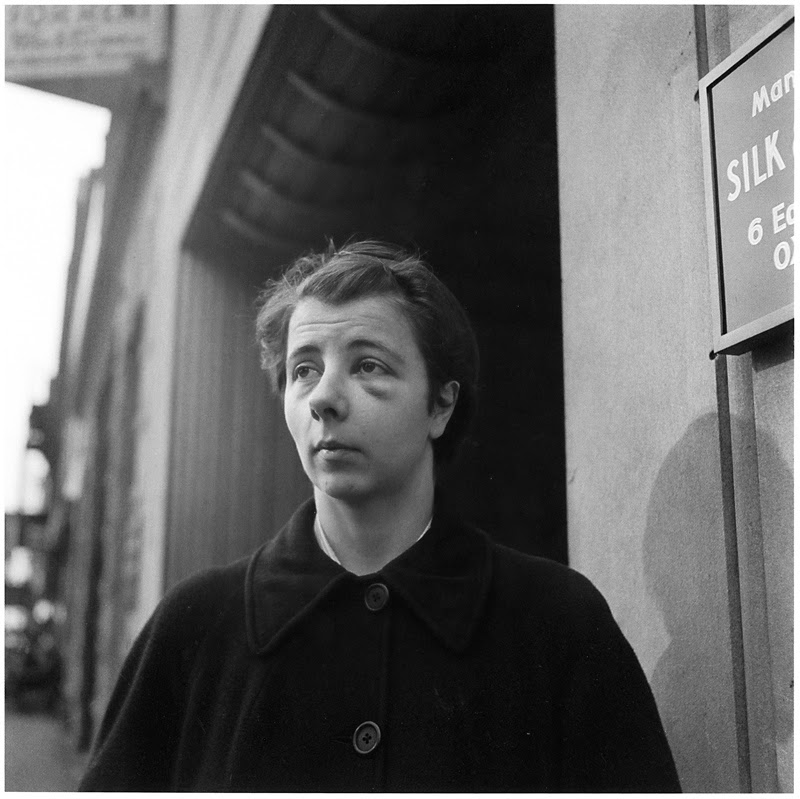
Nan One Month After Being Battered, 1984, Nan Goldin


Chicago, 1952, Vivian Maier

1963, Carl Mydans


1953, Vivian Maier

Cabana, 2000, Larry Sultan


Chicago, 1962, Vivian Maier

Versailles, 1975, Elliott Erwitt


Date and Location Unknown, Vivian Maier

Luxembourg Gardens, 2000, Richard Kalvar


Chicagoland, 1971, Vivian Maier

Untitled (Biloxi, MS), 1972, William Eggleston


1976, Vivian Maier

New York, 1982, Lee Friedlander

All Vivian Maier photos from A Photographer Found (Harper, 2014)

Wednesday, May 14, 2014

More thoughts on Maier

I finally got a chance to see Finding Vivian Maier recently. I have to say I was pleasantly surprised. Going in I wasn't sure what to expect. I have mixed feelings about Vivian Maier and the way her legacy and has been handled. And this was a debut film by an untested film-maker which had received a range of reviews. Was it just a big commercial? Would it reveal secrets? I couldn't tell. I didn't even know if I wanted to see it. 

But I'm glad I did, because it was a very entertaining film. John Maloof and Charlie Siskel have made a strong human interest story which comes alive on screen. I was impressed. It even turned out to be a good date movie. Tab liked it. I liked it. Note that mutual agreement is not always the case in such matters.

The title is no accident. To the extent a documentary can have narrative arc, it's the tale of Finding. Maloof has rounded up a wide range of people who knew her in person —maybe all of them?— and through their comments a detailed character study emerges. It's largely the Vivian Maier we'd known before —Mysterious, dowdy, street smart, eccentric, intensely private, sometimes good with kids, sometimes definitely not— but fleshed out more fully. We see the neighborhoods she lived in, she small French village she visited, her Chicago street haunts. Given her private nature the viewers of this film may know her as well as anyone ever has. 
Whether she would want millions of strangers to know her is another story. I think not. But it's too late now. She's been thoroughly found.

At the center of it all, wrapped up inextricably with her story, is John Maloof. If Maier is famous for her self portraits, Maloof has taken a page out of her book for this film. It's as much about him as her. Where would she be without him? He is the yang to Maier's yin. Whereas she was private to the point of pathology, Maloof is a public relations whiz. He is a natural on camera, a star in the making. He's got, what do they call it? —screen presence. In some ways the two of them are an unlikely pairing. But they say opposites attract, and Maloof's passion for Maier drives the film. In casual conversation he refers to her familiarly as "Vivian"— as if they were old friends. The kids she nannied remember her name differently —"That's Miss Maier to you," and don't forget it.  

If you still believe in the American Dream, Maloof is Exhibit A. He's found a niche, he's worked his ass off to develop it, and he now stands to reap the benefits. He's made it to Hollywood! This is what makes Maier's lifestyle so confounding to Maloof. Why didn't she pursue the American Dream? She had amazing talent —Hollywood level talent. Or at least New York level. So why did she remain a nanny rather than try for a career in photography? For someone with Maloof's ambition this is the central riddle  —it's the root of the dream, dammit— and it becomes the crux of the film. If the job of nanny is uncreative and of low social rank —the film's dubious premise— wouldn't she be happier in her true calling?

That question will probably never be answered, but let's take a stab. For one thing, it's not as if one can just push the Fine Artist button and launch a photography career. For someone in Maier's social position during that era, and especially considering the transgressive material she was producing, it would've demanded a convoluted path. It would've required a motivated patron who could develop art-world connections and a collector base. Someone like Maloof, in other words. But he wouldn't come around until many years later, and Maier was not the sort of personality to achieve this on her own. So that was a barrier.

But that's presuming she would rather be a full-time photographer than a nanny. The fact is her lifestyle allowed her to be both. It's not as if she was washing dishes in a windowless room, then pursuing photography on the side. Maier practiced photography on the job every day. She used her kids as foils and took them on photo adventures. Far from being unfulfilling, nannying was perfect. Unlike most jobs she could actually get some meaningful work done while on the clock.

Nannying may have been ideal but it was, alas, a job, and had many non-photographic responsibilities. I think that when it all boils down, the main reason she was a nanny is the same reason most artists have day jobs: she had to make a fucking living. Simple. Ask any barista what they really care about and you'll get the same story. Because the best photography is generally not made by full-time professionals. It's made by clerks, copy writers, bakers, landscapers, taxi drivers, auto mechanics...and, yes, nannies. Buried talent is not an anomaly in America. It's the norm. 

Seen in that light, the mystery of Vivian Maier becomes less confounding. But there's still the question of her photography. I think most photographers —at least outside of MoMA— have a sense of Maier's magic, but it's difficult to convey, and almost impossible to imagine what could develop such astonishing talent. What was her training? What photographers did she study? Who did she talk to, see, or like? What stages did she pass through? What's the story

Unfortunately the film offers very little background. We see some reproductions, some gallery shots, and there are short interviews with Joel Meyerowitz and Mary Ellen Mark saying why they think Maier is great. If you're a nonphotographer you'll just have to take their word for it.  

"But why are they so great?" Tab asked me afterwards. I wasn't sure what to tell her. They're great because Joel Meyerowitz said so? Because they're raw and real and incredibly tender? Or because they were taken by an unknown nanny?

"We'll have to wait for the sequel," I said.

Tuesday, April 29, 2014

Heir Apparent

My recent post on Vivian Maier's copyright sparked some interesting replies. By far the most surprising response I received was the news that Vivian Maier does in fact have an heir, and that all of the copyright issues regarding her work have been settled through that heir. This was reported by a knowledgeable source and confirmed by John Maloof. 

To the best of my knowledge, here's what happened. 

In order to make reproductions of Vivian Maier's work, and more importantly to sell that work through galleries, all outstanding copyright considerations needed to be settled. The problem for John Maloof, Jeff Goldstein, and anyone else wishing to market her work is that Maier had no known heirs, in which case copyright would've naturally reverted to the state of Illinois where she died. This copyright was probably worth very little when she died. But largely thanks to the efforts of Maloof, Maier's posthumous career has blossomed. The copyright is now worth a considerable sum.  

Maloof and Goldstein hired a genealogist —four of them actually— and visited a French village with connections to Maier. They were able to locate Maier's closest living relative, who was the heir and unwitting copyright owner. Maloof and Maier then made a legal arrangement which transferred copyright control to them, freeing the way for Maier's work to be sold. 

The heir wishes to remain anonymous. I don't know the identity, the relationship, or the legal arrangement. 

None of this is illegal or especially shocking. But I do think it transforms the general understanding of Vivian Maier's legacy (a good summary of the previous worldview is here). To my knowledge none of this information has not yet been reported in any media outlet.* In fact most stories about Maier continue to claim the opposite. The fact she died with no heirs feeds into the romantic fable. But as with all romance, the initial blush is beginning to wear off. What else might there be underneath?
_____________________________________________

*Update: Yesterday, this feature appeared in the Chicago Reader, also noting the copyright/heir connection.

Thursday, April 17, 2014

Dis Claimer

There was a problem with the Vivian Maier photo I posted yesterday. I had no right to reproduce it. According to the FAQ on vivanmaier.com, which is where I found the image,
All photographs appearing on this website and in the archive of the Maloof Collection are copyrighted and protected under United States and international copyright laws. The photographs may not be reproduced in any form, stored or manipulated without prior written permission from the Maloof Collection.
So John Maloof owns that photograph along with most of Vivian Maier's work. I want to take a moment now to give proper credit. That is John Maloof's photograph. He took it, at least in a manner of speaking. I did not get prior permission to post it. I broke copyright laws. But I don't really give a shit and here's why:

1. I backlinked to Maloof's site, giving him credit for the photo.

2. I used the photo to make a secondary point, possibly an academic one, and probably a very academic one, which exempts the post from copyright law under Fair Use doctrine.

3. I did not represent the photo as my own work. It is clearly labeled as Vivia— I mean, John Maloof's photograph.

I think I've taken proper steps to cover myself. After all, it's not as if I just found an old photo in storage, attached my name to it, claimed all rights, and sold limited editions of that photo for thousands of dollars. I could see how that might raise questions. But I'm not doing that so I should be covered. 

But if someone wants to sue me anyway, go for it.

Sunday, December 1, 2013

Forthcoming Titles

Already Published (2013)


Forthcoming Titles (2014)


Scheduled for Publication (2015)


Publication Date Uncertain


Wednesday, December 26, 2012

Maier at Hallward

For me the most noteworthy facet of the current Vivian Maier exhibit at Powell's Basil Hallward Gallery (drawn from the Goldstein collection) has nothing to do with the images. It's the fact that they are silver gelatin photos. That's a relative rarity nowadays, especially with contemporary work. Since the millennium began just 12 short years ago darkroom printing has quickly transitioned from mainstream to outlier.  Certainly there was no sign of it in last year's Vivian Maier exhibition at The Chicago Cultural Center which took the country by storm. Those were inkjets from scans, made according to current fashion.

Yes, the era of darkrooms has faded. But that happened to be the era that in which Vivian Maier lived. If she'd printed her own work during her lifetime they would've been silver gelatin prints made in a darkroom. So I think there's some poetic justice in applying that process now to her work. 


A shadow of the mysterious Maier, from the Goldstein Collection

The smallish (12 x 12) prints at Basil Hallward are probably better than Maier could've made on her own. The print quality is quite extraordinary. A crack-team of experts was hired for the task including master printers Ron Gordon and Sarah Steinbrecher from Chicago. They've done a bangup job with these. I did not see the Maloof show last year at any of its various stops, but it's hard to imagine those prints matching the craft on display here. 

In fact I think that may been some of the motivation to go down the silver gelatin route with these, to distinguish this show from the other one. Battle lines have been drawn. The two collections (Maloof Collection, Ltd and The Jeffrey Goldstein CollectionPerhaps the Ron Slattery collection will join the fray soon?) are basically competing for the same eyeballs, and of course the same pile of money. So any characteristic which is perceived as putting one above the other will probably be emphasized in the sales pitch. 


Wait a minute. Sales pitch? Yeah, sorry. I don't mean to reduce the show to a naked money grab, but there is certainly a golden goose dynamic here. If Goldstein had discovered a federal minting machine at an estate sale which could print old currency, the fallout would be roughly similar: Limited editions touring widely. The Basil Hallward prints start at $1800 and go up from there as the edition approaches the limit of 15. The other option is to buy the Deluxe Clamshell Edition book with print for $850. The Maloof Collection is structured similarly. One can buy prints or a book, or there is the additional option of buying the occasional vintage print made by Maier, for who knows how much.


Vivan Maier Deluxe Clamshell Book/Print Package

I suppose I can't begrudge anyone attempting to sell photos, and $1800 is near the going rate for a nice selenium-toned print by a respected artist. But at least when you buy a print from a living photographer you have a sense of direct support. Maybe they'll use the money for film or equipment or next month's rent. Or at least that's a story you can tell yourself. In this case? Not so much. Maier is dead. She has no heirs. Any sales proceeds will funnel straight to her self-appointed curators.  

I'm not exactly complaining here. I'm very glad these photos have been rescued and presented publicly. And I'm not naive. I know that collectors shape photographic history as much as photographs do. Still, the whole enterprise leaves me with a funny taste in my mouth.

But what of the photos? The Hallward show is very good. Not spectacular, but definitely worth seeing. This is in contrast to the Maloof Collection, which I would qualify as extraordinary based on what I've seen online. Whether it's through more conscious editing or because Maloof got the lion's share of what was out there, I give that collection the nod over Goldstein for sheer jaw-dropping impact. 


The curatorial approach is different as well. In contrast to Maloof's scatter-shot exhibition, The Hallward show puts Maier's work on a timeline and provides supporting historical text. We recount Maier's life, her early work with 35 mm, her transition to candid street portraiture, then her later fascination with formal abstraction. And of course running throughout her life are her hundreds of self-portraits which formed the default mode for her self expression. At the end of the timeline, after we read of her death and posthumous rediscovery, is the option to open the wallet and buy a chunk of her. It's a nice personal history but for me it was missing any explosive fireworks. There were no images here which stopped me in my tracks. But it was wonderful to see an entire wall of silver gelatin prints.

Vivian Maier is a continuing source of fascination for me. I love her photos. I love her life story. I will probably always enjoy any show or book of her work. I've written about her many times including here, here, here, here, and of course here in the early days of her rediscovery. 

But I can't help wondering what she might think of all this fuss over her? Would she approve? Or shrug it off? Would she demand a slice of the pie? Or would she just ignore it all and take her Rollei on a walk downtown? 

Vivan Maier: Out of The Shadows is at Basil Hallward Gallery, 3rd floor of Powell's, 1005 w Burnside in Portland through December 2012. 

Wednesday, January 12, 2011

Q & A with John Maloof

B: What was your photography background before acquiring Vivian Maier's work?

John Maloof: I had absolutely no photography background. I had a point-and-shoot camera that I used to take pics of homes for my real estate profession and for the historical society that I was president of at the time. I ended up taking a class at Wright College (a community college in my neighborhood) after I bought her rolls of film, but I dropped it after I learned to develop rolls and prints. I wanted to learn, first hand, how this process takes place and to get help with my own work in film.

I'm curious about the logistics of finding her work. There are a lot of old photos out there. It seems unusual for someone with no photo background to recognize so clearly how good these were. When you saw the work at auction, what was it that grabbed you? Did you decide immediately that you were interested or did it take longer to develop?

It's a rather long story, but I'll try to be as concise as I can. I was co-authoring a history book on the Chicago neighborhood Portage Park with a friend, Daniel Pogorzelski. We were looking for old local photos for the book. I saw that they were vintage and that there were a lot of images from Chicago, so I placed an absentee bid on the box, came back near the end of the auction, and realized that I had won. We both looked through the box, nothing was good for the book, so I stashed them in the closet for a few months.

When we finished the book, I started to scan them to see what I could use them for. Since I was quite involved in historic preservation on the city's Northwest Side at the time, the images were interesting to me from a historical perspective and the more "catchy" images are what caught my eye as someone who knew nothing about street photography. I found myself taking the same pictures that Vivian would take (here's an example ). I began following in her footsteps in mid 2008 and slowly got into photography by studying its history, reading books, watching the BBC 'Genius of Photography' special over and over on Tivo, etc. I started to get a feel for her work more as a street photographer over time. I then decided to collect the rest of her work and set out to do so, acquiring about 90-95% of what is known to exist.

As I understand it, there were two separate auctions for her work, and between the two auctions interest increased a great deal. I can see from the last answer how your own interest in her grew between the auctions, but what else was happening at the time that caused general interest to grow among others?

This auction house operates out of a resale store and they have auctions once a month (sometimes twice a month). Vivian's stuff was auctioned off about two or four weeks apart in between. Most of the people at the auctions are regulars and have their own business as flea marketers, eBayers, collectors, etc. I've been going to these auctions for many years now since it's literally a half block away from my home, in Portage Park. There were two auctions, but most of the work was in the second auction, the one that I attended. Vivian's possessions accounted for only a tiny fragment of what was being auctioned off. They have a giant space filled with many different things that go up for auction.

My interest in her work didn't grow between auctions because I was only at the second auction. These auctions are not geared toward fine art or photography, they mostly sell boxed lots of miscellaneous household items, antiques and furniture. Here's the website to give you an idea.


RPN Sales in Chicago, where Maier's work was auctioned

Keep in mind that our publisher Arcadia Publishing required approximately 220 high quality, antique photos of the subject matter. Both my co-author and I scoured places such as the Chicago Historical Society, Harold Washington Library, the Sulzer Regional Library, and a host of other institutions to try to find pertinent images. Chicago's Northwest Side (where Portage Park is located) is vastly unrepresented in these archives. In fact, this is probably the greatest challenge in writing a book from the 'Images of America' series. This is the reason why I was so interested in trying to find these local photos and willing to take a chance on a huge box full of negatives.

Your editing so far has been great. I'm curious if you have any help with that or just a natural sense of it. Can you give a sense of how much editing is happening? Are you showing 4 pictures per roll, 1 picture per roll, less than that. Are there many Maier shots that just flat out don't work, that you eliminate from consideration immediately?

Yes, I've been consulting experts such as Joel Meyerowitz, Ariel Meyerowitz and Colin Westerbeck from early on to seek advice. By the way, I'm trying to convince Joel to include Vivian in the next edition of Bystander and there's some likelihood that he will, which is very exciting.

He'll have to convince Westerbeck.

Joel cautioned me early on not to slant the work in ways to reflect other photographers such as Arbus or other influences. I've been careful to not just put what I think are the best images but, to post what I feel are strong images, factoring as much information and history as possible behind my decision. If I were to post all of only work that resembled, for example Institute of Design photographers, then, although it would still be good work, it would look like derivative work from photographers such as Callahan or Siskind or Ishimoto. There is no evidence of inspiration from these masters. However there is almost certainty some of it in some form, but since I don't know for sure then I can't slant it in only one direction since there may have been a several influences. Does that make sense?


Dark Alley, c. 1950s, Vivian Maier
Homage to Maier, 2009, John Maloof

I don't get help with my posts from anyone, actually. From the 10,000 negatives that have been scanned, I have edited roughly 900 strong images from them and that gets narrowed down to about 400 very strong images. From that folder, I visit it from time to time for a new post. I don't post everything at once, I'm not exactly sure why, I just don't.

Regarding the per-roll question, I'm not sure what roll they came from when they get posted, there's no frame of reference by that time.

But surely you must document which image comes from which roll. How else can you archive them?

Let me clarify. We haven't scanned any of the newly developed rolls yet really. All negatives are documented based on the writing from the vintage negative sleeves she kept them in, which, for the most part, have at least a date on them. They are organized and scanned in chronological order by date they were taken. The work is from 1951 to 1995, although I know she shot as recently as 2006, according to Central Camera shop here in Chicago.

But, based on my statement above she has a very good average for a photographer, in my opinion. And sure there are rolls that are completely not worthy of posting. From the immense research that my colleague, Anthony Rydzon, and I have conducted, we can place an fairly accurate time line on Vivian's life and work. The later work gets a bit different, not necessarily in a bad way, but it's definitely not as strong, especially her color work. So yes, many images don't make the cut. Actually most don't, which is only natural.

What is the process? Do you scan and archive every image regardless of its aesthetic quality? Do you make any sort of digital contact sheet or what?

Every single negative is scanned in as we go along, whether or not it's good. We don't create contact sheets. We just make small JPEG 'proof's', if you will, which makes scanning go faster. Joel has helped us install a system that can organize these much more efficiently which is what we're working on implementing currently.

Has your sense of Maier's work changed since you began editing? Are there some photos you included at first that you wouldn't now?

I have good reason to believe she began taking pictures in about 1949. Negatives from this year and even a year later have a beginner look to them. They are either over or under-exposed, out of focus, clumsy compositions, etc. But by the time she came back to New York from France in 1951, she had a good sense of her own interests and curiosities as a photographer. From 1951 to the mid-1970's, her work was solid with no noticeable learning curve from what I can tell.

From the mid 1970's through 1995, she definitely has a change in style. She switches to color in the mid 70's, uses a 35mm camera (mostly a Leica), and I get the feeling that she is seeing the world differently at that time. Her work becomes more abstract in some respects, but also very literal in others. I'll explain. Her abstract work often involves found objects either on the curb, in a garbage can or a similar setting. Some are quite good but there are so many that just leaving me scratching my head as to what she was trying to get across with the picture. The literal work is usually angled towards political, racial, or religious views. She seemed to be a liberal and of no known religious beliefs and so she would document graffiti, newspaper headlines, and racist slogans on park benches, for example. People were still in her photos, but it wasn't a dominating content at this time.

These are old rolls you're dealing with. Any noticeable defects after developing? Are you taking any precautions due to their age?

The rolls that are undeveloped have to do with the issues she was dealing with during her time line from what we discovered. She lived with the first family as a nanny for about 17 years and had the luxury of a darkroom to develop her rolls and to print with an enlarger. When she grew out of that job in 1971, then the undeveloped rolls started to pile up. This is roughly when they are dated too, from 1969-1974-ish. So this makes sense to me. The rolls are vintage and I have specifications to push them to the maximum amount of developing time before the emulsion separates from the backing. This results in most negatives developing perfectly. Only some have a very faint fog (an even fog, not spotty), but they have been perfectly salvageable so far. Since we don't know what directions to specify with each individual roll, they must follow the most safe guidelines that maximize the outcome for the rolls in general.

The color rolls on the other hand are not looking very good. They are mostly from 1970's-1980's and Ektachrome, color, 35mm. The few that have been tested have been unsalvageable. I'm hoping to figure out a solution and I plan to contact Kodak to see if they're interested in helping.

What do you expect to happen to all of her photos and negatives eventually? Do you anticipate owning them indefinitely?

This is something that I feel is too early on to know. Her collection was rejected by MoMA last year. I should definitely note that I have been consulting with some of the best (unbiased) experts in industry for advice on this matter such as Joel Meyerowitz. Joel has been a huge help over the past year. He's helped me facilitate a filing database for her work, the same one he uses for his own work. He has been generous at helping me figure out what my options are moving forward and has referred me to others that will be helping me in other specialized ways.

I understand that people want to know if I'm trying to cash in on this woman's work. That's not my mission. However, since I'm dealing with mostly negatives, the major institutions in the world don't seem interested in printing posthumous prints for their museums and I can understand why, in a way. This is the main problem that I honestly feel will make it difficult to get past with institutional housing of her work. Having said that, I feel that there is a way to find a middle ground and perhaps set up an institution that can eventually fund itself. I think the work needs to be out there and in order to do that there needs to be an income stream to fund it. I have not committed to this model yet and will only do so if it is the best possible option for preservation and promotion of Vivian's work.This is more important to me than than anything else.

What about raising funds by selling prints to collectors? Are the prints in the current show for sale?

I haven't been able to archive her vintage prints in order to document what I have to get to that step. I will eventually. I have over 3000 of them and I think that they should be enjoyed by others as well. The prints in the current show are not for sale. It is a public venue and just for public display.

Good luck with the project. I don't envy all the scanning hours in front of you, but it promises to be worthwhile.

Monday, December 27, 2010

Thoughts on Maier

Leave it to an investigative journalist to dig up the dirt. Nora O'Donnell's recent essay on Vivian Maier delves deeper into her backstory than anything else I've seen. Thanks, Chicago Magazine.


While the basic outline of her life life is now fairly well established, Maier still remains something of a mystery. For me the most intriguing questions center on her photographic skill. How did she gain such a sharp eye? What training did she have? Which photographers or photographs did she come in contact with? Who if anyone helped her develop? Or was she a pure autodidact?


The article doesn't really touch on these topics, probably because it's written from a journalist's point of view as a human interest story. When Phil Donahue asks “Is there a preponderance of evidence out there that these [photographs] are really special?” he is probably voicing the question on the lips of many nonphotographers. Boxes of dusty negatives? Doesn't everyone have those in their attic? What makes these any different? Most people are like Phil Donahue. They can't really judge.

It's up to the photography world to explain what sets these apart. Unfortunately the only photography expert quoted in the story has totally missed the boat. Colin Westerbeck says that the photos don't stand out from other Chicago photographs. Not enough irony or wit. Too much participation in the scenes. "The greatest artists," Westerbeck says, "know how to create a distance from their subjects."


What? I'm afraid I have to agree with Tiffany Jones here. That sounds like a complete load of shit. First of all, these photographs are as witty and cleverly constructed as any street photos out there. They may not be ironic, but since when is irony a requirement for quality, especially in mid-century photography?

Not distant enough from their subjects? I suppose that would discredit Arbus, Model, Hine, Atget, Sander, Weegee, Brassai, etc. Sorry guys, you'd be great artists if only you'd created more separation. Maybe Maier isn't as cool and calculated as Callahan or Ishimoto, but I actually view that as a plus. She's so present in her photos. It's an amazing gift. In short, critique is fine but please comment on what she is rather than what she isn't.

I suspect Westerbeck's assessment may have gotten sidetracked by Maier's storybook bio. Treasure trove nearly lost, found in an estate sale, etc. It's a great drama regardless of the photos.

But to me the story of Vivian Maier isn't that her work was lost and rediscovered. It's the work itself that matters. Her photographs are among the most vibrant street shots I've ever seen. I'm not sure which photos Westerbeck has already viewed, but I suggest he devote more hours to looking through Maier's archives. The quality and consistency of vision will prove impossible to miss.


The danger is that Westerbeck's Chicago Magazine opinion will set the tone for future appraisals. Once someone of his stature has chimed in other critics are likely to follow his cue. Worse, it may pave the way for misappreciation by society at large. Most folks are like Phil Donahue. They need a curator to tell them which photos are important and which aren't. To a layman writing or reading a magazine profile Westerbeck becomes the voice of authority.

The X factor in all of this is John Maloof (and now to a lesser extent Jeff Goldstein). Not only does he determine which images Westerbeck will judge, he controls which images any of us see. Although there are a few similar cases in history in which the fate of a photographer hinges on just one gatekeeper, this seems like an extreme example. To date, Maier's legacy has been completely tied to and dependent on Maloof. So far the editing has been wonderful. The images in this post —plucked at random from recent posts on Maloof's blog— are testament to that.
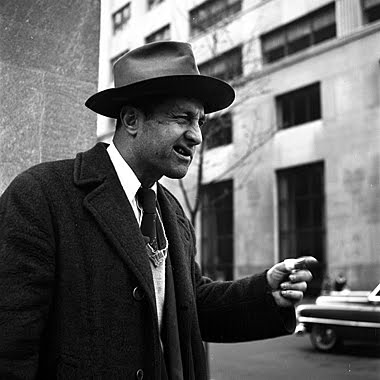
But I can't help wondering about the process. How much weeding out is occurring? How active is the curating? How much of what we are seeing is Maier's vision, and how much is Maloof's? Book, show, and film are forthcoming. I for one am looking forward to all of them.

Thursday, March 4, 2010

Gems

If you haven't checked in the Vivian Maier blog for a while, it might be worth a peek. John Maloof has been developing and posting photographs regularly ever since her initial big splash last October. Slowly but surely they are accumulating into an impressive oeuvre.
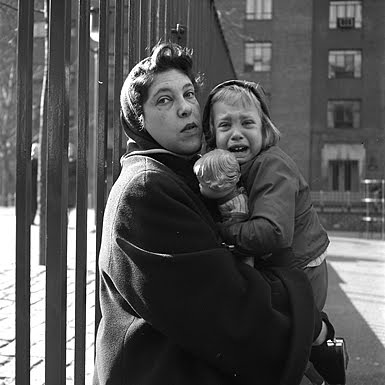
It remains to be seen how or if they might be collected into a book or a show. That ball is currently in Maloof's court. In the meantime, it's fun to check in every few weeks for the latest gems. Some recent favorites:


Monday, October 19, 2009

The Flame of Recognition

Now that the dust has begun to settle from last week's Vivian Maier maelstrom (with posts here, here, here, here, here, here, and here, not to mention here), it's time to dig a little deeper. Bryan Formhals poses the natural next question, "How many other Vivian Maiers are still out there undiscovered?"


Mr Folletete (Plitt) et Tupy, Paris, March 1912, J-H Lartigue
Virtually unknown until 1963

If the shifting tastes of history's gatekeepers are any guide, probably plenty. Giants such as Atget and Lartigue weren't recognized until very late in life, and the reputations of Watkins, Disfarmer, and E.J. Bellocq weren't made until after their deaths. Even 20th century keystone Walker Evans had fallen into near obscurity forty years ago before being resurrected in the 1970s. And of course currents can run the other direction. William Mortensen, anyone? Photographic history is in constant flux, and the inclusion of people like Maier in that history seems as dependent on chance and timing as on merit.

Probably the photographer whose story is most similar to Maier's is Angelo Rizzuto. Shooting the streets of New York in the 50s and 60s he amassed over 60,000 negatives which lay buried in total obscurity until Michael Lesy took an interest and published some of them posthumously in the 2005 book Angel's World. Rizzuto and Maier seem driven by the same internal logic, to just go out and make photographs obsessively with little regard for their later curation.


Self Portrait, 1960, Angelo Rizzuto
Virtually unknown until 2005

As interesting as Rizzuto's life was, I don't think his talent was in the same class as Maier's. There is a certain caged-animal intensity to them, as if he were making photographs not so much out of curiosity but simply because was helpless not to. Maybe he felt called, but that doesn't mean he'd found his calling. And indeed Lesy's interest seems spurred more by his lifestyle and outsider charm than his images.

To me, from what I've seen to date anyway, Maier was far more visually gifted. Her images are shockingly good. They deserve attention, a book, a show, whatever it takes. Looking at them I wonder Where in the world did she come from? How did she remain in obscurity all these years? And the least answerable question, How many other Vivian Maiers are still out there undiscovered?

I think plenty. Assessing the field of photography is as self selecting as measuring the unemployment rate. Only those actively looking for work are included in unemployment statistics, and those who've given up aren't counted. The fine art photo world operates in a similar way. It's very good at monitoring the progress of motivated self-promoters, but that is only one piece of the puzzle. Quietly obsessive folks like Vivian Maier are not included in the equation.


Chicago circa 1960, from the Vivian Maier blog
Virtually unknown until 2009

The situation has recently been complicated by the internet. In one sense it's great. The bar to distribution has never been lower, and anyone can get their work seen. When John Maloof wanted to get the word out about Maier the web was the natural channel. But what about all the people who don't use the internet? Yes, there still are some out there --Maier for one. I know a handful of other photographers with no web presence. They are great shooters but they're not part of the discussion.

The other X factor in recognition is a curatorial champion. Bellocq had Friedlander. Atget had Abbot. Disfarmer had Miller. Without their discoverers, these photographers might still be anonymous. For Maier it's been John Maloof. An interesting mental experiment is to wonder what would've happened had Maier posted her own photos on a blog while still alive. Would they have the same impact? Or would they just be another series of old images from some self-promoting has-been? Surely some of the intrigue in the situation and the interest in her photos comes from the storybook quality of their discovery. Such cases seemingly need an outside agent, someone aside from the photographer to direct society's attention. These folks are the historical gatekeepers.

All of which brings us to the curious case of Robert Bergman. Just last year, he was basically in the same boat as Vivian Maier. Yes, he'd published a book of portraits but that was many years ago. Since then his book had languished on the shelves in various used photography sections available for a few dollars. Bergman is an amazing talent and the book was fantastic. But who cared? Very few of us. So, like many wonderful photographers Bergman eventually sort of gave up. Figuring that his "emerge" date had passed, he stopped showing work in galleries, stopped showing to curators or collectors. By late middle age he had self selected himself out of the fine art photo equation.


from A Kind of Rapture by Robert Bergman
Published in 1998 but virtually unknown until 2009

But then something happened. What it was I have no idea. His work had been out there all these years. Nothing in it had changed, but all of the sudden people began caring about it. For whatever reason he was transformed overnight into hot shit, offered concurrent shows this winter here, here, and a here. Why? I'm stumped. Not that the work isn't deserving. It is and always has been great. But what changed and why now? Was it chance? Timing? Merit? More importantly, how many Bergmans are there out there undiscovered?

I think plenty.