A friend of mine has been bugging me for a while to try shooting square format so yesterday I spent a little while in downtown Springfield with my old Zeiss twinlens. I found a roll's worth of interesting looking people who agreed to have their portrait taken. I'm still undecided about the format. Square may or may not be for me.
What I did discover is that the old TLR is in some ways better for portraits than my Mamiya. For one thing you look down into it rather than through it. Maybe it's just me but this seems to allow for a less anxious dynamic during the portrait. When I look through a rangefinder at a stranger's face I feel like I'm right in their personal space. I feel like I want to take a step back to give them room. Generally the photos I make with that camera reflect this. They contain the person as well as a lot of the surrounding scene.
 Springfield, 2008
this man is dwarfed by the frameThe TLR is different. Instead of looking straight at the person I bury my face in the dark box to focus. I can see the person on the ground glass but the interaction is less direct. There is less of an invasion of personal space, and maybe also because I'm crowding the ground glass my unconscious action is to crowd the person a little too, fill the frame with them. So the TLR portraits are generally more about the person and less about how they fit into their surroundings.
But the biggest change with the TLR isn't any of that. The TLR is an old camera and I have to fiddle with it, and this fiddling creates a new dynamic. Maybe I should back up a little and explain. What usually happens when I approach someone for a portrait is this: About half say no and half say yes. The ones that say yes usually stand still and smile for my Mamiya the way they've done for all the "Cheese!" moments in their life. Sometimes I wait a moment for the smile to change but usually it doesn't and I just take the shot, and often it has a smile. I don't really want smiles in my photos --after all people don't typically walk around all day smiling-- but at the same time I don't want to give any direction to the subject. I want the portrait to be purely about how two strangers interact briefly around a camera and if that interaction involves smiling, so be it. At the same time, if given the choice I'd prefer not to have smiles.
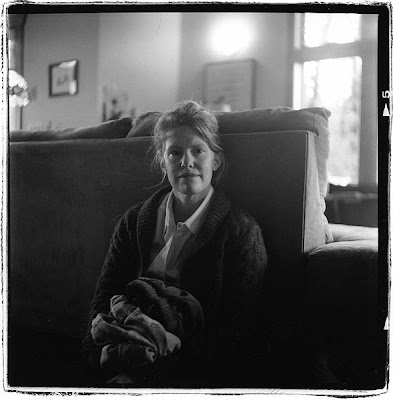 Jeanne McGowan, 2007
shot after fiddling with the cameraThe TLR seems to be a smile-reducer. What happens with the TLR is I get the photo set up and focused and the person stands there smiling, waiting for me to push the button. But then...wait a minute...I need to pull the camera away for a minute to check that I haven't bumped the aperture or shutter speed and to cock the shutter. When I get back over the camera often the person has gotten tired of smiling, and that's when I press the shutter. At least this is what happened a few times today.
I've heard Alec Soth describe shooting portraits with an 8 x 10 and I think the effect is the same. When you draw out the process a little you draw out the person.
 Quiz #7 is a spinoff of quiz #4. Below are eleven sets of photographers who share the same initials, listed by birth date and birth place. Your task is to identify the photographers. For example if the clue was 1937, Orange, NJ and 1923, NYC, the solution would be Robert Adams and Richard Avedon (both RA). Correctly identify all names and a free print is yours. Good luck. (Please don't submit a response if you've already won a print)


