 I'm a little late reporting this, but according to People Magazine I am now dating Jessica Simpson. If you believe that, you might want to give this a try.
Wednesday, October 1, 2008
News to me
I'm a little late reporting this, but according to People Magazine I am now dating Jessica Simpson. If you believe that, you might want to give this a try.

Tuesday, September 30, 2008
Drummer supported by mosh pit
Here's a photo of Monotonix drummer Ran Shimoni from their show last night with Silver Jews at Eugene's WOW Hall.
 I would've taken more photos but 1) it was hard to get close, and 2) I was scared of having my camera jarred out of my hand, and 3) recording Monotonix seemed to conflict with experiencing them. Anyway, Monotonix is friggin nuts! If they were a photographer they'd be Lucas Samaras on speed, cranked up to 11.
 I would've taken more photos but 1) it was hard to get close, and 2) I was scared of having my camera jarred out of my hand, and 3) recording Monotonix seemed to conflict with experiencing them. Anyway, Monotonix is friggin nuts! If they were a photographer they'd be Lucas Samaras on speed, cranked up to 11.
Monday, September 29, 2008
Keith Johnson
I like Keith Johnson's photos quite a bit.
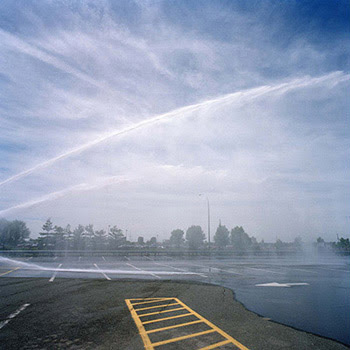
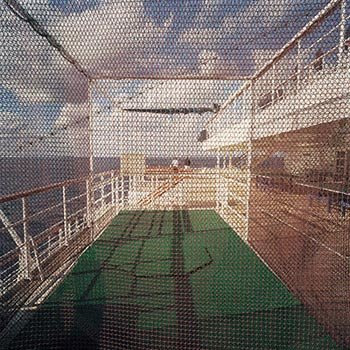
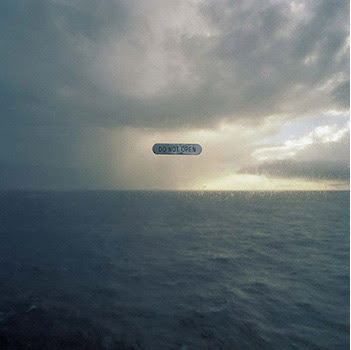

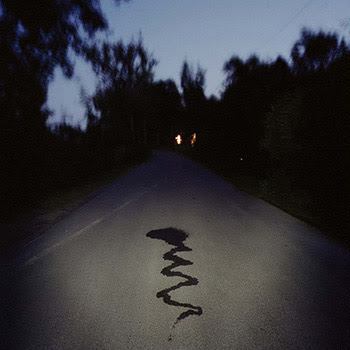
What I like about these is that they don't seem to be created with any preconceptions or grand calculations in mind. I think he was just out looking for interesting visual stimulation and these are a few of the scenes he found. That is photography reduced to its most essential element: Looking. Look here and here to see more of Johnson's photos.


What I like about these is that they don't seem to be created with any preconceptions or grand calculations in mind. I think he was just out looking for interesting visual stimulation and these are a few of the scenes he found. That is photography reduced to its most essential element: Looking. Look here and here to see more of Johnson's photos.
Sunday, September 28, 2008
Delightful experience
A few nights ago I left my headlights on while downtown and killed my car battery. It was about 8 pm and the quickest way home was to walk to a bus stop, take the #25 up Amazon Rd., then walk about a mile up a trail (shown below) through a forest that connects from Eugene to our road just outside of the city.
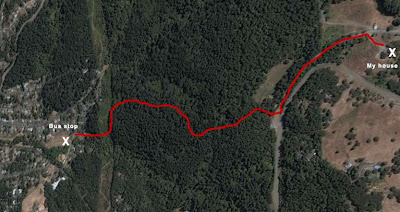
I've been on this trail countless times and I know it pretty well. It's my normal bike path between my home and town. But I had rarely done the trail in reverse, and never in the dark. And boy was it dark! The trail travels through dense woods which blocked the stars, there was no moon, no streetlights, I had no light of any kind. I know it's a cliche but I literally could not see my hands in front of me. I was totally blind.
Luckily the trail was very well worn. By slowly feeling with my feet I could find the level dirt area that told me I was on the path. Once in a while I'd step off into brush or into the hillside, and when this happened I'd correct myself. All in all it took about 40 minutes to travel the mile, and it was quite an interesting experience.
In the past few years, I think this is the longest I have been without light. When it's dark and I am at home or at a public place or in my car, there is always at least some small amount of light visible somewhere. When asleep we leave a nightlight on downstairs for the kids to find the bathroom. If I am sleeping outside there is often a natural ambient light of nighttime which permeates any open area, even in the darkest part of night. In virtually every public setting in America, streetlights or houselights are visible. In fact you really have to go to some effort to make your environment lightless, either tuck yourself in a closet or put on a blindfold, or stumble down a wooded path at night.
As someone whose daily photographic practice relies on the existence of light I found the lack of it enlightening and delightful. It some ways it was the opposite of photography.
Friday, September 26, 2008
Why 40 mm?
Mike Johnston has just republished on article of his from a few years back called "Why 40 mm?" Since I've been using a 40 almost exclusively for the past year, this was of particular interest to me. I wish I could say there was a grand plan behind my use of the 40, but honestly the main reason I bought one is that it was cheap. I found an f/2 40 mm Summicron-C online for about $400. The f/2 35 mm Summicron with virtually identical optics sells for about $1500 used. Given those options I bought the 40 and I've been quite happy with it.
What I like about the 40 is that it feels malleable. In some cases it can feel long, like a 50:
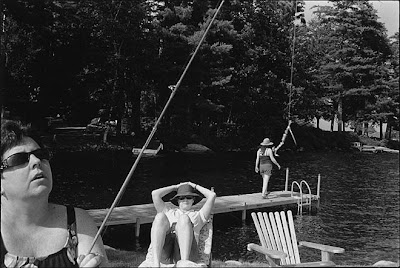
In other situations it feels wider angle, like a 35:

The flexibility is almost like using a zoom, but with one lens.
Years ago I did in fact use a zoom. I imagined I was giving myself the ability to react to everything. If something was close I could zoom wide angle. If something was far away I could telephoto in to crop close. The end result was that my photos had no consistency. They had the look of being taken by a variety of people. This is why Philip Perkis calls zooms "the work of the devil."
The first time I went to a fixed lens was quite a leap. What if there's a far away scene and I can't zoom in? What then? It took a little while but I got used to just one lens. Less is more in this case, i.e. less variables to mediate my worldview. After all, my eyes don't zoom in and out. Why should any other part of me do it?
What I like about the 40 is that it feels malleable. In some cases it can feel long, like a 50:

In other situations it feels wider angle, like a 35:

The flexibility is almost like using a zoom, but with one lens.
Years ago I did in fact use a zoom. I imagined I was giving myself the ability to react to everything. If something was close I could zoom wide angle. If something was far away I could telephoto in to crop close. The end result was that my photos had no consistency. They had the look of being taken by a variety of people. This is why Philip Perkis calls zooms "the work of the devil."
The first time I went to a fixed lens was quite a leap. What if there's a far away scene and I can't zoom in? What then? It took a little while but I got used to just one lens. Less is more in this case, i.e. less variables to mediate my worldview. After all, my eyes don't zoom in and out. Why should any other part of me do it?
Subscribe to:
Posts (Atom)